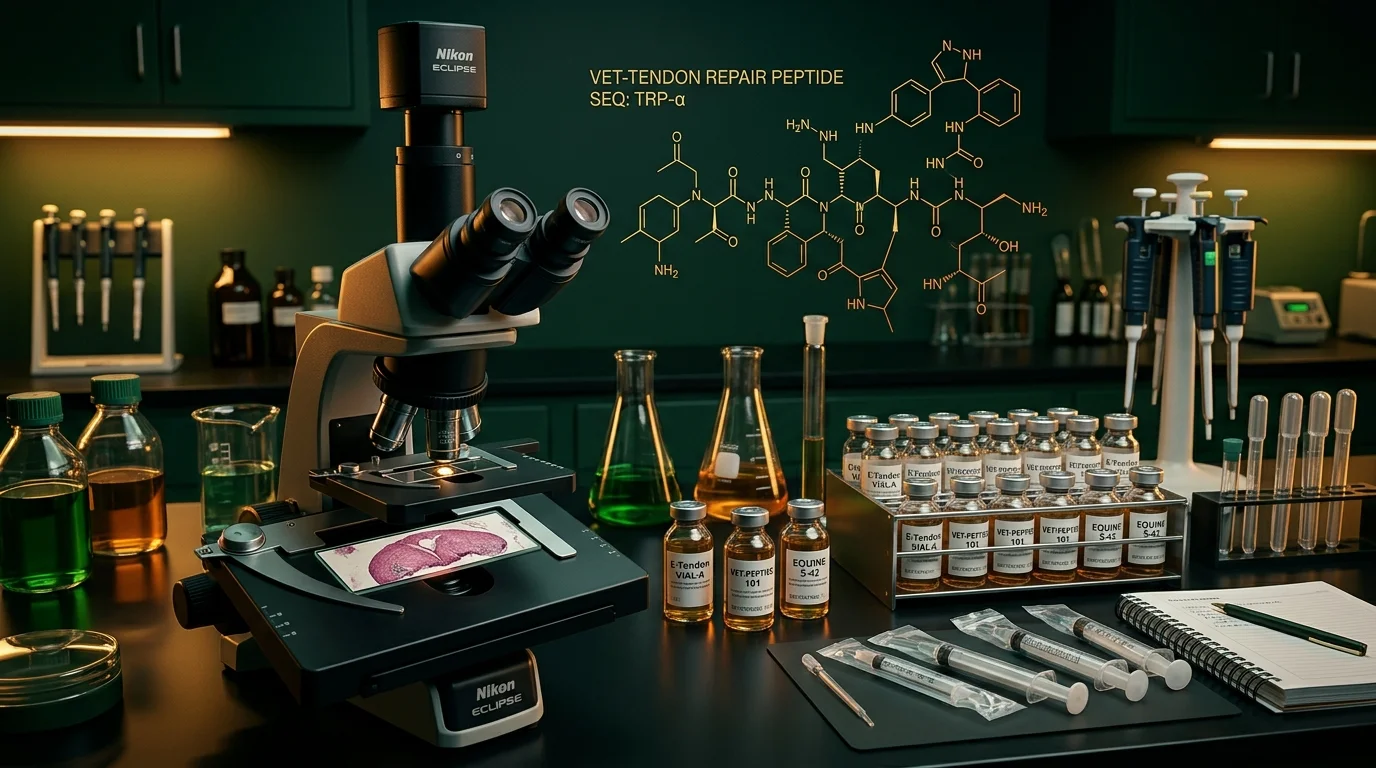

The field of research peptides in veterinary medicine sits at a genuinely productive crossroads. On one side, you have decades of human-focused peptide pharmacology. On the other, a sprawling set of animal biology questions that pharmaceutical development has largely left unanswered. Horses with chronic tendon injuries, dogs with inflammatory bowel disease, rodent models yielding mechanistic data that human trials can't ethically replicate. These aren't peripheral concerns. They're where some of the most informative pre-clinical peptide science is quietly happening, and the field deserves a clearer map.
This overview is that map. It covers what research peptides actually are, why veterinary contexts are scientifically valuable, which peptide classes have drawn the most animal research attention, and what the regulatory and quality landscape looks like for investigators working in this space.
A peptide is simply a chain of amino acids, shorter than a full protein. The body produces thousands of them naturally: signaling molecules, hormones, fragments of larger proteins with their own biological activity. Research peptides are synthetic versions of these endogenous sequences, or novel analogs designed to mimic or modulate their activity. They're manufactured for laboratory and investigational use, not as dietary supplements.
That distinction matters. Protein supplements, collagen powders, and amino acid blends are food-category products. Research peptides are pharmacologically active compounds studied for specific biological effects. BPC-157, for instance, is a 15-amino-acid sequence derived from a gastric protein. It doesn't occur in significant concentrations in any food source. Thymosin beta-4 is an endogenous peptide present in virtually all tissues, but the synthetic version used in research, often called TB-500 in animal contexts, is a specific fragment studied for its actin-binding and tissue-repair properties. These are not supplements with a marketing rebrand. They're investigational compounds with defined sequences, measurable purity requirements, and a growing body of pre-clinical literature behind them.
The "research" designation also carries a real regulatory meaning. These compounds are not approved therapeutic agents in most jurisdictions. They're studied in controlled settings, in animal models, to understand mechanisms, safety profiles, and potential biological activity. That's the context this site operates within.
Animal research isn't just a stepping stone toward human applications. In many cases, it's the endpoint. Horses develop musculoskeletal injuries with biomechanical and histological features that genuinely differ from rodent models. Canine gastrointestinal physiology shares meaningful overlap with human GI biology. Large-animal models offer tissue sample volumes, imaging resolution, and longitudinal follow-up windows that small-animal and cell-culture work simply can't match.
There's also an honest welfare argument here. Companion and performance animals suffer from conditions, tendinopathy, wound healing complications, inflammatory bowel disease, neurological injury, for which existing treatment options are limited. Research into peptides that might address these conditions isn't academic abstraction. It's work that could translate directly into better outcomes for animals that are already patients.
Veterinary research also sidesteps some of the ethical constraints that limit human clinical investigation. Controlled diet studies, tissue biopsy protocols, and pharmacokinetic sampling that would be difficult in human trials are feasible in appropriately managed animal research settings. This makes veterinary models particularly useful for studying peptide bioavailability, tissue distribution, and dose-response relationships. The data generated has translational value in both directions.
The peptide research landscape in veterinary and animal science contexts isn't monolithic. Several distinct classes have attracted serious investigational attention, each with its own mechanistic focus and body of evidence.
BPC-157 is probably the most studied peptide in animal research contexts right now. It's a synthetic pentadecapeptide derived from a human gastric juice protein, and rodent model data suggests it has activity across a striking range of tissue types: gastrointestinal mucosa, tendon, bone, skeletal muscle, and nervous tissue. Studies published in peer-reviewed journals including the Journal of Physiology and European Journal of Pharmacology have examined its effects on wound closure rates, angiogenesis, and inflammatory marker expression in rodent models.
What makes BPC-157 interesting in veterinary contexts specifically is that its proposed mechanisms, upregulation of growth hormone receptor expression and modulation of nitric oxide pathways, are relevant to conditions common in performance animals. Equine tendon research is one area where this has begun to attract attention, though the published equine-specific literature remains limited compared to the rodent evidence base.
Thymosin beta-4 is an endogenous 43-amino-acid peptide with well-documented roles in actin sequestration and cell migration. The research compound TB-500 is a fragment of this sequence, studied specifically for its effects on tissue repair and inflammation in animal models. Equine athletes have been a focus of informal investigation for years, partly because tendon and soft tissue injuries are so economically significant in that population. Peer-reviewed equine studies remain sparse, but rodent model findings on muscle regeneration and wound healing have been published in journals including Annals of the New York Academy of Sciences.
Thymosin alpha-1 occupies a different niche. It's been studied primarily for immune modulation, with animal model data examining its effects on T-cell activity and cytokine profiles. This makes it relevant to veterinary immunology research in ways that the musculoskeletal-focused thymosins are not.
GHK-Cu is a naturally occurring tripeptide-copper complex found in human plasma, urine, and saliva. It was first isolated in the 1970s, and the research literature on its wound-healing properties in animal models spans several decades. Studies have examined its effects on collagen synthesis, antioxidant enzyme expression, and skin repair in rodent and porcine models. The porcine wound model is particularly relevant because pig skin shares structural characteristics with several domestic animal species, making GHK-Cu findings more directly translatable than some other peptide research.
Peptides in this class, including GHRP-2, GHRP-6, and ipamorelin, stimulate the release of endogenous growth hormone through ghrelin receptor pathways. Animal model research has examined their effects on body composition, bone density, and recovery from catabolic states. In veterinary research contexts, these compounds are studied for their potential relevance to conditions involving muscle wasting, recovery from surgery, and metabolic dysregulation. The endocrine pharmacology here is reasonably well characterized in rodent models, though large-animal data is less abundant.
This is an area where clarity matters and confusion is common. Research peptides occupy a specific regulatory category: they're investigational compounds, not approved veterinary drugs. In the United States, the FDA regulates veterinary drugs under the Federal Food, Drug, and Cosmetic Act, and research compounds used outside of approved IND or INAD frameworks exist in a legally complex space. Similar frameworks apply in the EU, UK, and Australia, where veterinary medicine regulations are administered by bodies including the EMA and APVMA.
For legitimate research use, the key is operating within institutional frameworks: IACUC approval for animal studies in the US, equivalent ethics committee oversight elsewhere, and appropriate documentation of compound sourcing and use. Research peptides are not licensed for clinical veterinary therapeutic use in most jurisdictions. That's not a loophole or a technicality. It's a meaningful distinction that shapes how these compounds should be sourced, stored, and used.
The regulatory picture is also evolving. As pre-clinical evidence accumulates for compounds like BPC-157 and TB-500, there's growing interest in formal veterinary clinical trial frameworks. That's a positive development for the field, even if the timeline is uncertain.
Not all peptides are equal. In research contexts, compound quality directly affects data validity. A peptide with significant impurity profiles or sequence errors doesn't just produce unreliable results. It can introduce confounding variables that compromise an entire study.
The quality markers that matter most in research settings are sequence verification, typically confirmed via mass spectrometry, purity grade (research-grade compounds are generally held to higher purity standards than bulk industrial synthesis), sterility testing for compounds intended for injectable use in animal studies, and proper cold-chain storage documentation. Investigators sourcing compounds for animal research should expect suppliers to provide certificates of analysis from independent third-party laboratories, not just internal testing documentation.
Lyophilized (freeze-dried) peptide preparations are standard for research use because they offer better stability than liquid formulations during storage and shipping. Reconstitution protocols, typically using bacteriostatic water, are well established in the research literature. These aren't minor logistical details. They're part of the experimental design.
The articles below go deeper into specific compounds and research contexts. Each one focuses on a particular peptide or methodological question, drawing on the available pre-clinical literature to give investigators and interested readers a grounded picture of where the evidence stands.
Animal peptide research is genuinely understudied relative to its potential. The species diversity of veterinary contexts, the translational relevance of large-animal models, and the real welfare stakes for animal patients all argue for taking this field seriously. The evidence base is growing, the questions are good ones, and the animals that might benefit from better answers deserve careful, rigorous science on their behalf.
This article is for informational and research purposes only. Nothing in this content constitutes veterinary or medical advice, a treatment recommendation, or an endorsement of any specific compound, supplier, or protocol. Research peptides are investigational substances not approved for veterinary therapeutic use in most jurisdictions. Always consult a licensed veterinarian before making any clinical decisions. For research purposes only, not veterinary advice.