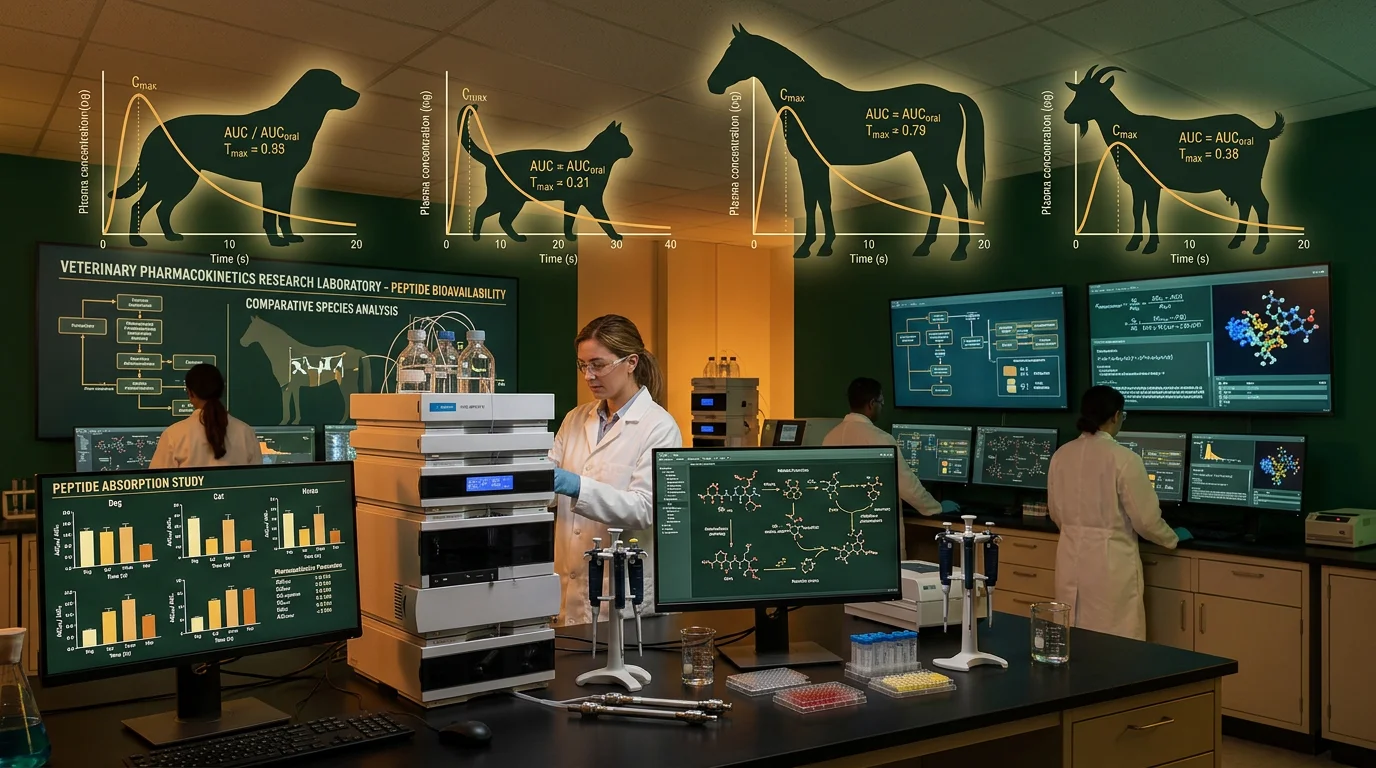

Peptide bioavailability in animals is one of the most persistently underestimated variables in veterinary pharmacology research. When investigators compare findings across species, they're often comparing apples to something that only superficially resembles fruit. The compound may be identical. The route of administration may appear identical. But the biological environment receiving that compound differs so profoundly between a mouse and a horse that the pharmacokinetic outcomes can be nearly incomparable. Understanding peptide bioavailability animals research demands starts with accepting this translation problem as the central challenge, not a footnote.
This isn't a new concern. Comparative pharmacokinetics has long grappled with species-dependent variability in absorption, distribution, metabolism, and excretion. Peptides add layers of complexity that small-molecule drugs don't carry. They're larger, enzymatically labile, and their behavior in biological fluids changes depending on pH, temperature, and the specific protease environment of a given species' gastrointestinal tract or plasma.
What follows is a careful look at the delivery variables that matter most in animal research settings, from route of administration to species-specific clearance rates, with particular attention to why rodent data so frequently fails to translate cleanly into large-animal contexts.
Understanding delivery and absorption is foundational to interpreting the research reviewed in our veterinary peptide research overview.
The intuitive assumption is that body mass drives most pharmacokinetic differences between species. Allometric scaling is real and useful, but it's incomplete. A 500 kg horse and a 25 g mouse don't just differ in scale. They differ in gastrointestinal anatomy, metabolic rate per unit body mass, plasma protein binding characteristics, hepatic enzyme activity, and renal clearance efficiency in ways that scaling equations can only partially account for.
Metabolic rate is inversely proportional to body size. Smaller animals burn through compounds faster. A rodent's higher mass-specific metabolic rate means peptides are cleared more rapidly, which affects half-life calculations significantly. Research published in comparative pharmacology literature has consistently shown that peptide half-lives measured in rodent models are shorter than those observed in larger species, sometimes by an order of magnitude.
Body composition also plays a role that's easy to overlook. Peptides with any degree of lipophilicity distribute differently in animals with varying fat-to-lean ratios. A lean athletic horse and an obese laboratory rodent represent dramatically different distribution volumes, affecting both peak plasma concentrations and duration of exposure.
Plasma protein binding is another species-specific variable. Albumin concentration and binding affinity differ between dogs, horses, and rodents, altering the fraction of free peptide available for tissue distribution and receptor interaction. This is rarely controlled for when rodent findings are extrapolated to equine or canine research contexts.
Most peptides don't survive oral administration. That's not an overstatement. The gastrointestinal tract is an extraordinarily hostile environment for peptide bonds, and the defenses begin before the compound even reaches the small intestine.
Salivary and gastric proteases initiate degradation at low pH. Pancreatic enzymes in the duodenum, including trypsin, chymotrypsin, and elastase, continue the process with considerable efficiency. Brush border peptidases on intestinal epithelial cells finish what the luminal enzymes started. The result, for most unmodified peptides, is that oral bioavailability hovers near zero.
Rodent gastrointestinal anatomy compounds this further. Rats and mice lack a gallbladder, which affects bile acid concentration and the overall digestive environment. Horses are hindgut fermenters with a cecum and large colon that harbor microbial communities capable of additional peptide degradation. Dogs have a relatively simple GI tract compared to horses, but their gastric pH and transit time differ meaningfully from rodents.
Research into modified peptide delivery, including cyclization, PEGylation, and nanoparticle encapsulation, has been studied for its potential to improve oral bioavailability in animal models. Cyclic peptides are structurally more resistant to proteolytic cleavage, and some rodent studies have demonstrated measurable oral absorption of cyclized analogs that their linear counterparts fail to achieve. Whether these findings translate to large-animal GI environments remains an open question with limited published data.
Subcutaneous administration is the most common delivery route in peptide animal research, and for good reason. It bypasses first-pass hepatic metabolism, allows for relatively consistent absorption kinetics, and is technically straightforward across species. Bioavailability via subcutaneous injection for many peptides has been studied at 70 to 90 percent of intravenous dosing in rodent models, though this figure varies considerably by compound and species.
The subcutaneous space differs between species in ways that matter. Rodents have a loose, highly vascularized subcutaneous layer that facilitates rapid absorption. Horses and dogs have denser connective tissue in many injection sites, which can slow absorption and extend time-to-peak plasma concentration. This affects the pharmacokinetic profile even when the total bioavailability is comparable.
Intramuscular delivery introduces additional variables. Muscle blood flow, which varies with the animal's activity level, ambient temperature, and health status, directly affects absorption rate. In horses, intramuscular injection sites also carry infection risk considerations that have led many equine researchers to prefer subcutaneous or intravenous routes where feasible.
Intravenous administration provides the most controlled pharmacokinetic baseline. It's the route used to establish true half-life and clearance values. For peptides like BPC-157, much of what's known about systemic exposure comes from intravenous rodent studies, and the BPC-157 equine research context highlights how much remains unknown about whether those kinetics translate to large-animal species.
Half-life data from rodent models is probably the most frequently misapplied figure in peptide research discussions. A compound with a 20-minute plasma half-life in a rat does not have a 20-minute half-life in a horse. The relationship between body size and metabolic clearance means the horse's half-life will be substantially longer, though predicting the exact value requires species-specific pharmacokinetic studies that often haven't been conducted.
The general principle from comparative pharmacology is that half-life scales with body mass raised to approximately the 0.25 power. This means a 500 kg horse might be expected to have a half-life roughly 8 to 10 times longer than a 25 g mouse for a compound eliminated primarily by metabolic clearance. Renal clearance scales somewhat differently, and peptides cleared primarily by renal filtration may show different interspecies scaling than those metabolized hepatically.
Dogs occupy an interesting middle position. Their pharmacokinetic data often translates more predictably to human medicine than rodent data does, which has made them a preferred large-animal model for some peptide research. Canine plasma half-life values for several research peptides have been published, and they generally fall between rodent and equine predicted values, consistent with allometric expectations.
One honest limitation worth acknowledging: the published pharmacokinetic data for most research peptides across veterinary species is genuinely sparse. Investigators frequently have to work from rodent data and allometric projections because species-specific studies simply haven't been funded or published. This is a real constraint on the field, not a solvable problem with current literature.
Peptide bioavailability in animal research isn't only a biological question. It's also a handling question. Peptides are structurally fragile. Improper reconstitution or storage can degrade a compound before it ever reaches the animal, producing null or misleading results that reflect handling artifacts rather than true pharmacology.
Most research peptides are supplied as lyophilized powders, which are stable at low temperatures but sensitive to moisture, heat, and repeated freeze-thaw cycles once reconstituted. Bacteriostatic water is commonly used for reconstitution in research settings because it extends the usable life of the solution compared to sterile water alone. The specific diluent matters: pH, ionic strength, and the presence of preservatives all affect peptide stability in solution.
Temperature during storage is critical. Reconstituted peptide solutions stored at 4°C may remain stable for days to a few weeks depending on the compound, while storage at room temperature can accelerate degradation substantially. Freeze-thaw cycling degrades many peptides through aggregation and denaturation, which reduces effective concentration without any visible sign of degradation in the vial.
Light exposure is another variable that receives less attention than it deserves. Some peptides are photosensitive, and storage in amber vials or protected from direct light is standard practice in careful research protocols. When bioavailability studies produce unexpected variability, handling and storage conditions should be among the first variables examined.
Topical peptide delivery has been studied primarily in dermatological contexts, with rodent skin wound models generating a meaningful portion of the published data. The challenge is that skin permeability varies considerably across species. Rodent skin is thinner and more permeable than equine or canine skin, and the lipid composition of the stratum corneum differs in ways that affect transdermal absorption.
Penetration enhancers, including dimethyl sulfoxide and various carrier systems, have been studied for their ability to improve topical peptide delivery in animal models. DMSO in particular has a long history in equine research as a carrier compound, though its effects on peptide stability and the skin's barrier function introduce their own variables.
Intranasal delivery is an area of growing interest in rodent neuroscience research, with some peptides studied for their potential to reach central nervous system targets via the olfactory route. Whether this approach has practical relevance in veterinary large-animal research is unclear, given the anatomical differences in nasal passages between rodents and horses or dogs.
The translation problem that runs through all of this research is real, persistent, and worth naming directly. Rodent models have driven the majority of peptide pharmacology research for practical and economic reasons. But every time a finding from a mouse model is discussed in a large-animal context, the pharmacokinetic assumptions embedded in that translation deserve scrutiny. Species-specific studies, even small ones, provide data that allometric scaling simply cannot. The field would benefit from more of them.
This article is for informational and research purposes only. Nothing in this content constitutes veterinary or medical advice, a treatment recommendation, or an endorsement of any specific compound, supplier, or protocol. Research peptides are investigational substances not approved for veterinary therapeutic use in most jurisdictions. Always consult a licensed veterinarian before making any clinical decisions. For research purposes only, not veterinary advice.