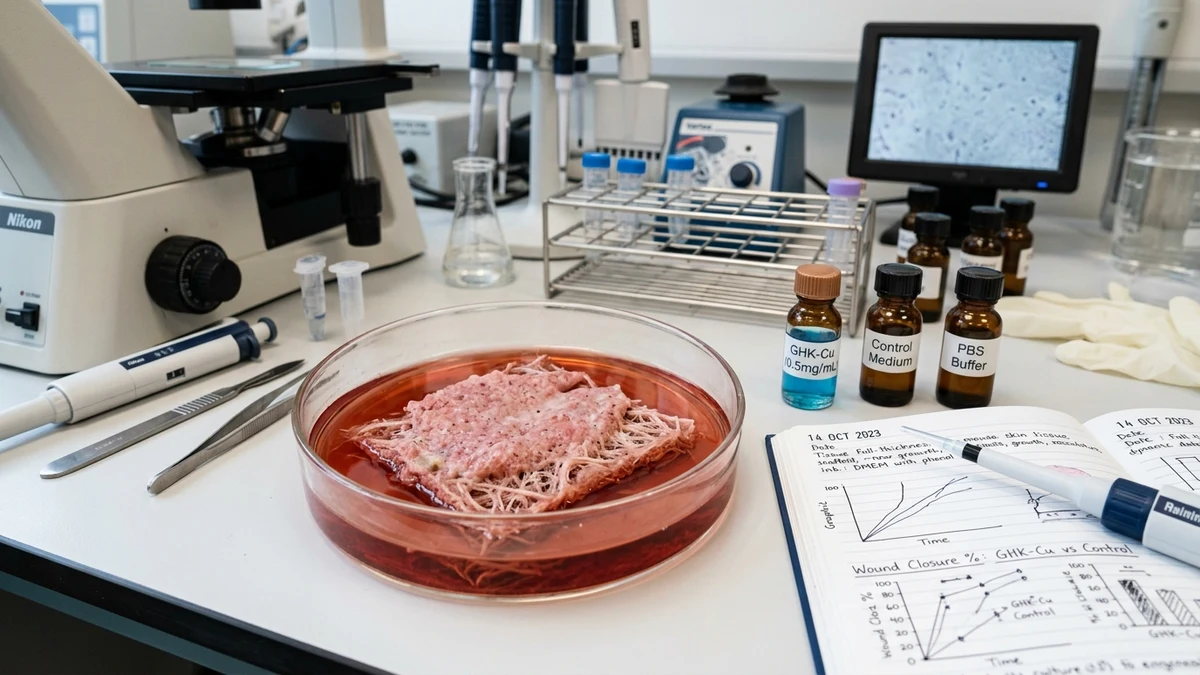

GHK-Cu wound healing veterinary research sits at a genuinely interesting intersection: a naturally occurring peptide with decades of human dermatology literature behind it, now being examined through the lens of animal models and species-specific wound biology. GHK-Cu, or glycyl-L-histidyl-L-lysine copper(II), is a tripeptide first isolated from human plasma in the early 1970s by Loren Pickart. It binds copper ions with high affinity, and that copper-peptide complex appears to drive a range of tissue-remodeling activities, including fibroblast activation, collagen and glycosaminoglycan synthesis, and modulation of inflammatory cytokines. For veterinary researchers focused on wound healing, those properties are worth paying close attention to.
Wounds in horses and chronic skin conditions in dogs represent some of the most stubborn problems in veterinary dermatology. Equine lower limb wounds are notorious for exuberant granulation tissue, sometimes called "proud flesh," which disrupts normal healing architecture and leads to poor cosmetic and functional outcomes. In dogs, chronic ulcerative lesions, pressure sores, and post-surgical wounds that fail to close cleanly are recurring frustrations. Conventional wound management has improved, but the underlying biology of stalled or dysregulated healing hasn't changed. That's where peptide compounds like GHK-Cu enter the research conversation.
The peptide itself is endogenous. Humans and other mammals produce it naturally, and plasma concentrations decline with age, a pattern that has led researchers to ask whether topical or systemic supplementation could restore some of that biological signaling capacity in aging or injured tissue. GHK-Cu is one of several peptide compounds generating research interest in veterinary contexts. The research peptides veterinary medicine overview maps the broader field.
Understanding why GHK-Cu attracts wound healing researchers requires a close look at its known mechanisms. The peptide's copper-binding capacity is central. Copper is an essential cofactor for lysyl oxidase, the enzyme responsible for cross-linking collagen and elastin fibers. Without adequate copper signaling, newly synthesized collagen lacks tensile strength. GHK-Cu has been studied for its ability to deliver bioavailable copper directly to fibroblasts and keratinocytes, the cells most involved in wound repair.
Fibroblast activation is one of the most consistently reported findings in GHK-Cu cell culture and rodent studies. Research has shown that GHK-Cu stimulates fibroblasts to proliferate and migrate into wound beds, a process critical for granulation tissue formation. It has also been studied for its effects on matrix metalloproteinases (MMPs), the enzymes that remodel damaged extracellular matrix. Specifically, pre-clinical data suggests GHK-Cu may help balance MMP activity, promoting degradation of damaged matrix while protecting newly forming tissue from excessive enzymatic breakdown.
Anti-inflammatory signaling is another area of active investigation. Rodent model data suggests GHK-Cu can downregulate pro-inflammatory cytokines including TNF-alpha and interleukin-6, while potentially supporting anti-inflammatory pathways. Chronic wounds in companion animals are often characterized by a persistent, low-grade inflammatory state that prevents progression through normal healing phases. A compound that modulates that inflammatory environment without broadly suppressing immune function is a compelling research target.
The most substantive pre-clinical wound healing data for GHK-Cu comes from rodent excisional wound models and, more relevantly for veterinary purposes, porcine skin studies. Pig skin shares meaningful structural similarities with mammalian wound biology more broadly: epidermal thickness, dermal architecture, and healing kinetics in pigs are closer to those seen in dogs and horses than rodent models typically are.
Studies using topically applied GHK-Cu in rodent models have reported accelerated wound closure rates, increased collagen deposition, and improved tensile strength of healed tissue. A study examining copper peptide formulations in full-thickness excisional wounds found measurable differences in re-epithelialization speed compared to vehicle controls, with GHK-Cu-treated wounds showing earlier keratinocyte migration across the wound bed.
Porcine model data adds another layer. Research using GHK-Cu in partial-thickness porcine wound models has examined not just closure speed but wound quality, specifically the organization of collagen fibers in healed tissue. Disorganized, scar-like collagen is a hallmark of poor healing, particularly relevant in equine wounds where fibrosis and granulation tissue overgrowth are common. Some porcine findings indicate that GHK-Cu-treated wounds develop more organized collagen architecture, though the mechanistic explanation for this is still being worked out.
The anti-fibrotic dimension of GHK-Cu research deserves its own discussion, because fibrosis is not a minor footnote in veterinary wound care. It's often the primary problem.
Exuberant granulation tissue in horses is essentially a fibrotic process that has escaped normal regulatory control. The wound doesn't fail to heal; it heals in a dysregulated way, producing excess fibrous tissue that protrudes above the wound surface and resists epithelialization. In dogs, fibrotic scarring after burns, deep lacerations, or chronic ulcers can cause contracture and long-term functional impairment. Any compound that helps regulate the fibroblast-to-myofibroblast transition, the cellular event that drives pathological fibrosis, is worth studying carefully.
GHK-Cu has been studied for its effects on transforming growth factor beta-1 (TGF-beta1), a central driver of fibrosis. Pre-clinical findings indicate that GHK-Cu may modulate TGF-beta1 signaling in ways that reduce myofibroblast differentiation and collagen overproduction. This is speculative territory for veterinary application, but the mechanistic logic is sound, and the equine wound care research community has taken notice. Whether these anti-fibrotic signals translate meaningfully in large animal wound environments remains an open question that needs species-specific study.
How GHK-Cu is delivered matters enormously, and this is an area where veterinary research faces real practical constraints. Most of the existing data involves topical application, which makes sense for wound healing contexts. Topical delivery places the peptide directly at the site of action, and GHK-Cu's relatively small molecular size (the tripeptide itself has a molecular weight under 341 Da without copper) theoretically supports transcutaneous penetration into the dermis.
That said, skin penetration in veterinary species isn't uniform. A horse's skin differs from a dog's, and both differ from the rodent or porcine models used in most studies. Hair follicle density, epidermal thickness, and lipid composition of the stratum corneum all affect how topically applied peptides behave. Researchers interested in translating GHK-Cu findings to equine or canine contexts need species-specific penetration data, which is currently sparse.
Systemic delivery introduces different challenges. Peptides are generally susceptible to proteolytic degradation in the gastrointestinal tract, and oral bioavailability for tripeptides varies considerably depending on formulation and species. Injectable routes preserve peptide integrity but raise different questions about distribution, tissue targeting, and dosing windows. For a deeper look at how these delivery challenges play out across animal research models, the discussion of peptide delivery and bioavailability in animal models covers the key variables researchers are working with.
Encapsulation strategies, including liposomal and nanoparticle-based formulations, have been studied in the context of improving GHK-Cu skin penetration and stability. Some in vitro data suggests encapsulated forms may maintain higher local concentrations in dermal tissue compared to free peptide, but in vivo veterinary data using these formulations is limited. This is a legitimate gap in the literature.
It would be easy to read the GHK-Cu literature and come away with uncritical enthusiasm. The mechanistic story is coherent, the pre-clinical data is suggestive, and the veterinary need is real. But there are genuine limitations that any honest appraisal has to acknowledge.
Most GHK-Cu wound healing studies have used rodent models, which heal differently from horses and dogs in ways that matter. Rodents heal primarily by contraction; humans and horses heal more by re-epithelialization. Results from rodent excisional wound models don't translate automatically to large animal wounds or chronic canine ulcers. The porcine data is more encouraging from a translational standpoint, but porcine wound studies specifically designed to model equine healing challenges are rare.
Standardization is another issue. GHK-Cu formulations vary across studies in terms of peptide concentration, copper ratio, vehicle composition, and application frequency. Comparing outcomes across studies is difficult when the intervention itself isn't consistent. For veterinary researchers designing new studies, this means establishing reliable formulation parameters before drawing conclusions about efficacy.
There's also the question of wound chronicity. Most pre-clinical studies examine acute wound healing, where the biological environment is relatively predictable. Chronic wounds in dogs, particularly those complicated by infection, poor perfusion, or underlying systemic disease, present a very different biological landscape. Whether GHK-Cu's signaling effects can meaningfully penetrate a biofilm-laden, hypoxic wound bed is not well established.
My honest assessment: GHK-Cu is one of the more mechanistically credible peptide candidates for veterinary wound research, but the species-specific data needed to support real translational work is still being built. The human dermatology literature provides a useful scaffold, not a finished answer.
The path forward for GHK-Cu in veterinary wound healing research runs through better-designed, species-specific studies. Equine wound models that specifically examine exuberant granulation tissue, combined with histological analysis of collagen organization and myofibroblast markers, would generate the kind of data that could actually inform clinical research directions. Canine chronic wound models, particularly those that incorporate the complicating factors of infection and poor tissue perfusion, would be equally valuable.
Comparative pharmacokinetic studies in horses and dogs, examining how topically applied GHK-Cu distributes through skin layers and what local tissue concentrations are achievable, would also help clarify whether delivery strategies developed for human skin translate to veterinary species. Collaboration between veterinary dermatologists, equine surgeons, and peptide biochemists is probably the most productive structure for this work.
The biology of GHK-Cu is genuinely interesting, and the veterinary wound care problem it might address is genuinely significant. Horses with chronic limb wounds and dogs with non-healing ulcers represent patients whose suffering is real and whose treatment options remain imperfect. Rigorous, species-specific pre-clinical research is the appropriate next step, and there's enough mechanistic foundation to make that research worth doing carefully.
This article is for informational and research purposes only. Nothing in this content constitutes veterinary or medical advice, a treatment recommendation, or an endorsement of any specific compound, supplier, or protocol. Research peptides are investigational substances not approved for veterinary therapeutic use in most jurisdictions. Always consult a licensed veterinarian before making any clinical decisions. For research purposes only, not veterinary advice.