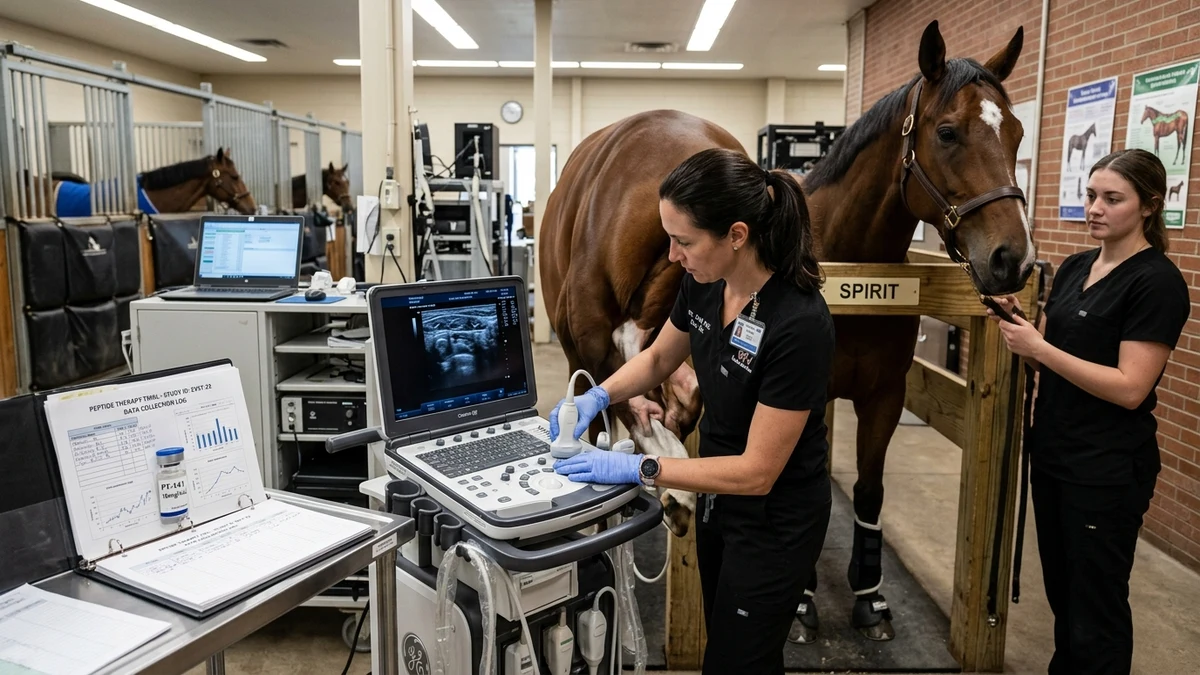

BPC-157 equine research sits at a genuinely compelling intersection: a peptide with a well-characterized pre-clinical profile meeting one of veterinary medicine's most persistent clinical problems. Horses tear tendons. They develop gastric ulcers at rates that would alarm any sports medicine physician. Their bone remodeling under athletic load creates stress fracture risks that end careers and, too often, lives. The body protection compound known as BPC-157, a 15-amino-acid synthetic peptide derived from a protein found in gastric juice, has accumulated a meaningful body of pre-clinical data across exactly these tissue categories. That's why exercise scientists and veterinary researchers have started paying attention.
The peptide itself was first described in research out of the University of Zagreb, where Predrag Sikirić and colleagues spent decades characterizing its effects in rodent models. BPC-157 doesn't appear to work through a single mechanism. Pre-clinical findings point to activity across multiple pathways: upregulation of vascular endothelial growth factor (VEGF), modulation of nitric oxide synthesis, interaction with growth hormone receptor signaling, and what researchers describe as a cytoprotective effect on epithelial and endothelial tissue. That's a broad mechanistic footprint, and it explains why the compound keeps appearing in studies spanning gut mucosa, musculoskeletal tissue, and bone.
For anyone studying equine athletes specifically, the appeal is structural. The horse's superficial digital flexor tendon (SDFT) is a high-strain energy-storing structure that fails in ways that look, biomechanically and histologically, quite similar to Achilles tendinopathy in human runners. Recovery timelines are long, re-injury rates are high, and the veterinary field has limited pharmacological options backed by strong evidence. A peptide with pre-clinical angiogenic and fibroblast-stimulating properties is, naturally, going to attract research interest in that context.
For a broader context on peptide research in veterinary settings, see our research peptides veterinary medicine overview.
Understanding why researchers study BPC-157 in equine models starts with its mechanism. The compound appears to influence the FAK-paxillin pathway, which plays a role in cell migration and adhesion. Rodent model data suggests BPC-157 accelerates the movement of fibroblasts and tendon-derived cells toward injury sites, a process central to early-phase tissue repair.
The VEGF connection is particularly relevant for tendon research. Tendons are notoriously hypovascular tissues. Poor blood supply is one reason they heal slowly and incompletely. Studies in rodent models have shown BPC-157 administration associated with increased VEGF expression and capillary formation in healing tissue. Whether that vascular response translates proportionally to the much larger tissue volumes in horses is an open question, and it's one of the honest limitations the field hasn't yet resolved.
Growth hormone receptor interaction adds another layer. Research suggests BPC-157 may upregulate GH receptor expression in tendon fibroblasts, potentially amplifying the tissue-building signals that growth hormone normally provides. This pathway is of particular interest in aging or repeatedly injured tendons where receptor sensitivity may be reduced.
The most frequently cited pre-clinical work on BPC-157 and musculoskeletal tissue comes from transection and crush injury models in rats. A series of studies from the Zagreb group demonstrated that BPC-157-treated animals showed faster return of tensile strength, improved collagen organization, and reduced inflammatory infiltration compared to controls in Achilles tendon transection models. The histological findings, specifically the shift toward organized Type I collagen rather than disorganized scar tissue, are what caught equine researchers' attention.
Horses healing from SDFT core lesions face exactly this problem. The natural repair process tends to deposit Type III collagen, a mechanically inferior tissue that predisposes to re-injury. Any compound that pre-clinical data suggests might shift that balance toward Type I collagen is worth studying in species-appropriate models.
It's worth noting that comparable work has been done with other peptides in equine musculoskeletal contexts. Thymosin beta-4 studies in equine musculoskeletal research have examined similar endpoints, particularly around actin sequestration and anti-inflammatory signaling in tendon tissue. The two peptides operate through distinct mechanisms, which makes comparative pre-clinical research genuinely informative rather than redundant.
Ligament studies in rodent models have shown broadly similar findings to tendon work. Medial collateral ligament transection models treated with BPC-157 demonstrated improved biomechanical properties at healing timepoints compared to controls. For horses, where suspensory ligament injuries are a leading cause of performance loss, these findings provide a rationale for investigating BPC-157 in larger animal models, though that work remains limited in the published literature.
Gastric ulcer syndrome affects an estimated 60 to 90 percent of performance horses, depending on the population studied and the diagnostic criteria used. That prevalence alone makes any compound with pre-clinical gastroprotective properties worth examining in equine contexts.
BPC-157's gastrointestinal profile is, honestly, where its pre-clinical evidence base is strongest. The compound was originally isolated from gastric juice, and the bulk of early research examined its effects on gastric mucosal integrity. Rodent models of ethanol-induced, NSAID-induced, and stress-induced gastric lesions consistently showed protective and healing effects in BPC-157-treated animals. The proposed mechanisms include upregulation of cytoprotective prostaglandins, modulation of nitric oxide pathways, and direct effects on gastric mucosal cell survival.
Beyond the stomach, rodent model data suggests BPC-157 has been studied for effects on intestinal anastomosis healing, short bowel syndrome models, and colitis. In larger animal models, including some pig studies, findings have been broadly consistent with the rodent data, though the species differences in gastrointestinal physiology mean direct extrapolation requires caution.
For horses, the right hindgut is as important as the stomach. Colonic disturbances, including right dorsal colitis associated with NSAID use, represent a serious welfare and performance concern. Pre-clinical findings suggesting BPC-157 has been studied for intestinal epithelial protection and mucosal healing make it a logical candidate for investigation in equine hindgut models, though published equine-specific GI data remains sparse.
Racehorses develop stress fractures, particularly in the third metacarpal bone and the proximal sesamoids, at rates that reflect the extraordinary mechanical demands placed on these structures. Pre-clinical bone repair research on BPC-157 is less extensive than the soft tissue literature, but it exists.
Rodent segmental defect models and fracture models have shown BPC-157 associated with increased callus formation, improved bone mineral density at healing sites, and faster radiographic evidence of bridging compared to controls. The proposed mechanism here involves both the angiogenic effects described above (bone repair is profoundly vascular-dependent) and possible direct effects on osteoblast activity.
One rodent study examined BPC-157 in a model of corticosteroid-induced bone loss, finding that treated animals showed attenuated bone density reduction. This is of indirect relevance to equine medicine, where corticosteroid use in joint management is common and concerns about long-term bone effects are real.
The honest limitation here: bone healing research in horses involves tissue volumes, mechanical loading patterns, and remodeling timescales that differ enormously from rodent models. Pre-clinical bone findings in rats generate hypotheses for equine research, not conclusions.
There's a reason equine medicine has become an important translational bridge between rodent pre-clinical work and human sports medicine. Horses are large athletes who sustain high-load, repetitive-use injuries in ways that small animal models simply don't replicate. Their tendon biomechanics, their cardiovascular responses to training, and their musculoskeletal pathology patterns have more in common with elite human athletes than a rat on a treadmill does.
This makes the horse genuinely valuable as a research model, not just a patient population. When a peptide like BPC-157 shows pre-clinical promise in rodent tendon models, studying it in horses serves two purposes: it advances equine veterinary knowledge, and it provides a larger-animal data point that informs the translational pathway toward human research.
Equine researchers also benefit from relatively well-standardized injury models. The SDFT core lesion can be created and monitored with high-field MRI and ultrasound with a precision that allows meaningful outcome measurement. That methodological infrastructure makes horses attractive for peptide research beyond just the clinical need.
Pre-clinical enthusiasm has to be tempered by what's actually missing. There are no large, controlled, peer-reviewed studies of BPC-157 in horses published in the major equine veterinary journals as of this writing. The evidence base is built on rodent models, a handful of larger animal studies, and mechanistic reasoning. That's a foundation for research interest, not clinical application.
Pharmacokinetics in horses are unstudied. The peptide's stability, distribution, and clearance in a 500-kilogram athlete are unknown. Dosing extrapolation from rodent data is not straightforward. These aren't minor gaps. They're the core scientific work that needs to happen before BPC-157 equine research moves from hypothesis to evidence.
There's also the question of route of administration. Most rodent studies have used either systemic injection or local application. Oral administration has been studied for gastrointestinal effects in rodents, but the oral bioavailability question in horses, with their complex fermentative hindgut, is genuinely unresolved. Intra-lesional injection, the route most relevant for tendon work, introduces its own variables around distribution and local tissue response.
The field needs controlled equine studies. It needs pharmacokinetic data. It needs histological outcome measures from horse-specific injury models rather than extrapolations from rat Achilles tendon work. The pre-clinical signal is interesting enough to justify that investment. What researchers shouldn't do is treat rodent findings as a proxy for equine clinical evidence. The gap between the two is real, and closing it is the actual scientific work that remains ahead.
This article is for informational and research purposes only. Nothing in this content constitutes veterinary or medical advice, a treatment recommendation, or an endorsement of any specific compound, supplier, or protocol. Research peptides are investigational substances not approved for veterinary therapeutic use in most jurisdictions. Always consult a licensed veterinarian before making any clinical decisions. For research purposes only, not veterinary advice.