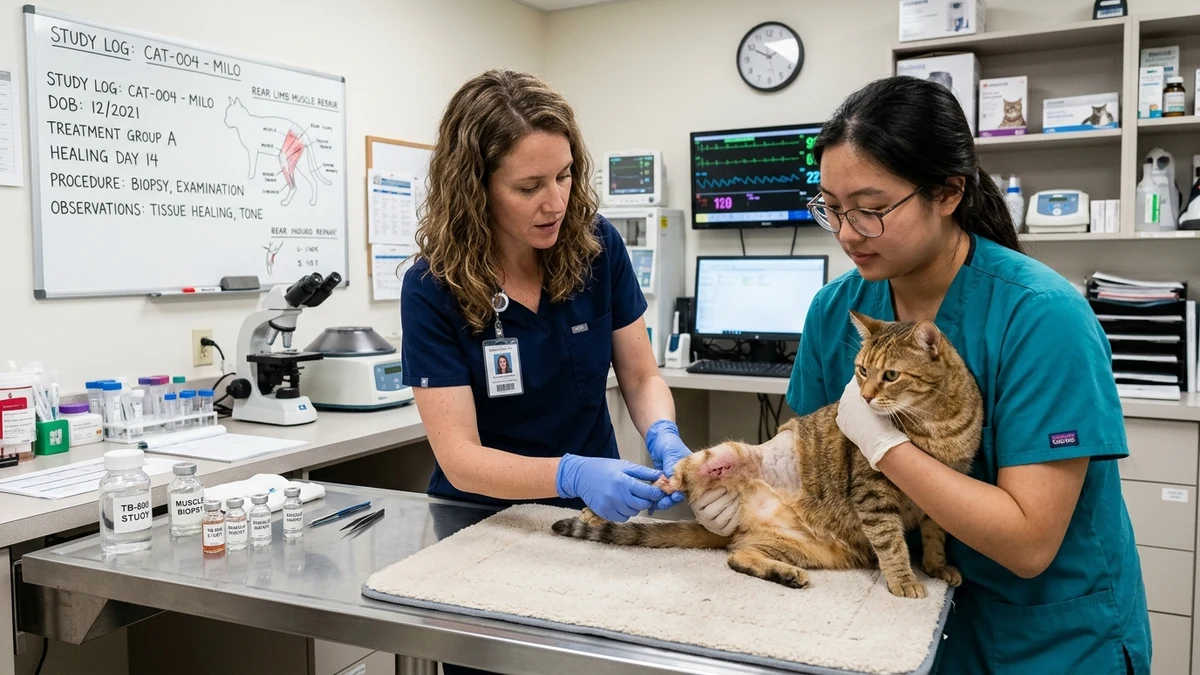
TB-500 cats feline research sits at an intriguing intersection of veterinary science and peptide biology. Thymosin beta-4, the endogenous protein from which the synthetic analog TB-500 is derived, has been studied across multiple species for its roles in tissue repair, cellular migration, and inflammatory modulation. Cats present a particularly compelling research population: they're obligate carnivores with distinctive metabolic profiles, they sustain musculoskeletal injuries at rates comparable to active dogs, and their wound-healing physiology has been documented as meaningfully different from rodent models used in most foundational peptide studies. As interest grows in species-specific applications of peptide research, feline models are receiving more attention from preclinical investigators.
This article is for informational and research purposes only. Nothing here constitutes veterinary or medical advice, and no content should be interpreted as guidance for treating any animal or human condition. TB-500 and related peptides are research compounds. Consult a licensed veterinary professional before making any health decisions for an animal in your care.
TB-500 is a synthetic peptide fragment derived from thymosin beta-4 (Tβ4), a naturally occurring protein found in virtually all nucleated mammalian cells. The full-length Tβ4 protein plays a documented role in actin sequestration, a process central to cell motility and tissue remodeling. TB-500 isolates a specific amino acid sequence from that protein, one believed to be responsible for much of its activity in promoting cellular migration toward injury sites.
Cats produce endogenous thymosin beta-4, as do most mammals. The feline version shares high sequence homology with human and rodent forms, which is one reason researchers consider feline subjects potentially relevant to translational work. High sequence homology doesn't guarantee identical bioactivity across species, but it does make the cat a more physiologically appropriate subject than some alternatives.
Feline musculoskeletal research has historically lagged behind canine research, partly because cats are less commonly used as working or athletic animals and partly because cat owners have traditionally had fewer intervention options presented to them. That gap is narrowing. Practitioners working in sports medicine for performance cats (including show cats and certain working breeds) have begun documenting anecdotal outcomes that parallel findings in equine and canine peptide research.
Cats are digitigrade animals, meaning they walk on their toes, and their musculoskeletal architecture is optimized for short-burst speed and precision jumping. This makes tendons, ligaments, and the small stabilizing muscles of the limbs particularly load-bearing and particularly vulnerable to acute strain injuries. Cranial cruciate ligament injuries, metacarpal and metatarsal strains, and muscle tears from falls are among the more commonly documented feline musculoskeletal problems.
Research on thymosin beta-4 in musculoskeletal repair has examined its potential to support satellite cell activation (the precursor cells responsible for skeletal muscle regeneration), tendon fibroblast migration, and the regulation of inflammatory cytokines at injury sites. Studies in rodent and equine models suggest that Tβ4 may influence the rate at which myogenic precursor cells migrate to damaged tissue. Whether the same mechanisms operate with equivalent efficiency in feline tissue is not established with certainty, but the cellular machinery involved, including actin dynamics and integrin signaling, is conserved across mammalian species.
One acknowledged limitation of feline-specific TB-500 research is the near-total absence of controlled clinical trials. Most available information comes from case reports, veterinary practitioner accounts, and extrapolation from other species. This matters because cats metabolize compounds differently from dogs in several documented ways, and the pharmacokinetics of peptides in feline subjects deserve direct study rather than assumption.
Research also touches on feline joint health in the context of osteoarthritis, a condition affecting a substantial proportion of older cats according to radiographic studies published in veterinary literature. Thymosin beta-4 has been examined in articular cartilage models for its potential influence on chondrocyte behavior and synovial inflammation. These are early-stage findings, and none constitute approved therapeutic claims, but they inform why researchers continue to include feline subjects in preclinical design discussions.
Feline skin is notably thinner than human or canine skin, and cats are known among veterinary professionals for their tendency toward wounds that close poorly or develop complications like abscesses following bite injuries. The biology of feline wound healing involves the same fundamental phases seen in other mammals: hemostasis, inflammation, proliferation, and remodeling. The timeline and efficiency of each phase, though, can differ.
Thymosin beta-4 has been studied for its role in each of the repair phases. Research in rodent and human tissue models points to its involvement in keratinocyte and endothelial cell migration during the proliferative phase, processes critical for re-epithelialization and new blood vessel formation. For feline wound research, the question is whether these same signaling pathways are activated with sufficient potency to meaningfully accelerate repair in a species where wound complications are clinically common.
Some veterinary researchers have noted that cats' grooming behavior introduces a complicating variable in wound studies. Cats lick wounds compulsively, which disrupts topical applications and alters the local wound environment. This makes systemic or injectable research administration more relevant in feline models than topical delivery, a factor that shapes how TB-500 research protocols are designed in this species.
Related research on BPC-157 in gastrointestinal and connective tissue contexts has generated parallel interest in how peptide combinations might influence wound healing. While BPC-157 and TB-500 have distinct mechanisms, their simultaneous appearance in preclinical literature has prompted investigators to examine potential complementary activity. This doesn't mean the compounds are interchangeable or equivalent; it means the broader peptide research space is increasingly cross-referencing findings across compounds and species.
One area where feline TB-500 research intersects with broader peptide biology is inflammatory regulation. Chronic low-grade inflammation underlies many feline conditions, from dental disease to inflammatory bowel disease to the joint changes associated with aging. Thymosin beta-4 has been studied for its potential to modulate NF-kB signaling pathways, which sit upstream of many pro-inflammatory cytokine cascades.
This matters for musculoskeletal recovery because the resolution of acute inflammation, not just its suppression, appears to be critical for proper tissue remodeling. Research suggests that incomplete inflammatory resolution is associated with fibrosis and scarring rather than regenerative repair. Tβ4's potential role in facilitating this resolution phase, sometimes called active inflammation resolution, is a growing area of preclinical interest.
Feline immune function has some characteristics that make this area particularly worth studying. Cats are susceptible to chronic inflammatory conditions at rates that some researchers attribute partly to their evolutionary diet and metabolic specialization. Understanding how an endogenous protein like thymosin beta-4 participates in feline immune signaling could have implications beyond just wound healing or muscle repair.
Research on peptide hormones like growth hormone secretagogues has also raised questions about how systemic peptide administration affects tissue recovery across species. In feline subjects, the interaction between peptide compounds and the distinct feline endocrine environment is not fully characterized. Cats lack certain hepatic enzyme pathways present in other mammals, and this could plausibly affect peptide metabolism, though direct evidence for TB-500 specifically in feline liver metabolism is sparse.
Researchers designing feline studies around TB-500 face several practical challenges that don't arise, or arise differently, in rodent or large animal models. Cats are notoriously difficult research subjects from a compliance standpoint. Their stress responses to handling are well-documented and can confound outcomes by activating cortisol-related pathways that independently affect tissue healing and inflammation.
Sample size is another limiting factor. Feline research cohorts tend to be smaller than rodent cohorts, which limits statistical power and makes it harder to draw firm conclusions from observational data. This is why the current body of TB-500 feline evidence remains largely anecdotal or extrapolated, even when practitioner reports are consistently directional.
Study design in this area also needs to account for feline-specific biomarkers. Serum markers of muscle damage, inflammatory mediators, and tissue remodeling proteins don't have fully validated reference ranges in cats for all research contexts. This creates interpretive gaps when trying to quantify the magnitude of any effect a research compound might have.
From an ethical standpoint, feline research subjects require careful welfare oversight, particularly for studies involving injectable compounds or repeated tissue sampling. Institutional animal care protocols for cats are well-established, but researcher experience with feline-specific handling and stress minimization is essential to producing clean data.
Researchers interested in how musculoskeletal peptide research translates across species may find it useful to review equine thymosin beta-4 literature, which has a somewhat larger evidence base and shares some of the biomechanical loading characteristics relevant to feline limb function. Cross-species triangulation, while imperfect, helps researchers form more refined hypotheses before committing to dedicated feline trials.
TB-500 cats feline research remains in early stages, fragmented across case reports, cross-species extrapolation, and a small number of targeted preclinical observations. That's not a dismissal of the field. It's a description of where early-phase translational research characteristically sits before controlled trials accumulate.
The mechanistic rationale for studying TB-500 in feline subjects is sound: cats have the cellular machinery that thymosin beta-4 interacts with, they present clinically relevant injury patterns that align with the compound's proposed mechanisms, and their distinct physiology makes species-specific study genuinely informative rather than redundant. What's missing is the methodologically rigorous trial data that would let researchers move beyond "research suggests" into established findings.
For practitioners and researchers following this space, the honest position is watchful attention. The early signals are worth investigating. The hard work of controlled study design, peer-reviewed publication, and species-specific pharmacokinetic profiling remains ahead.
For research purposes only — not medical advice.