For research purposes only — not medical advice.
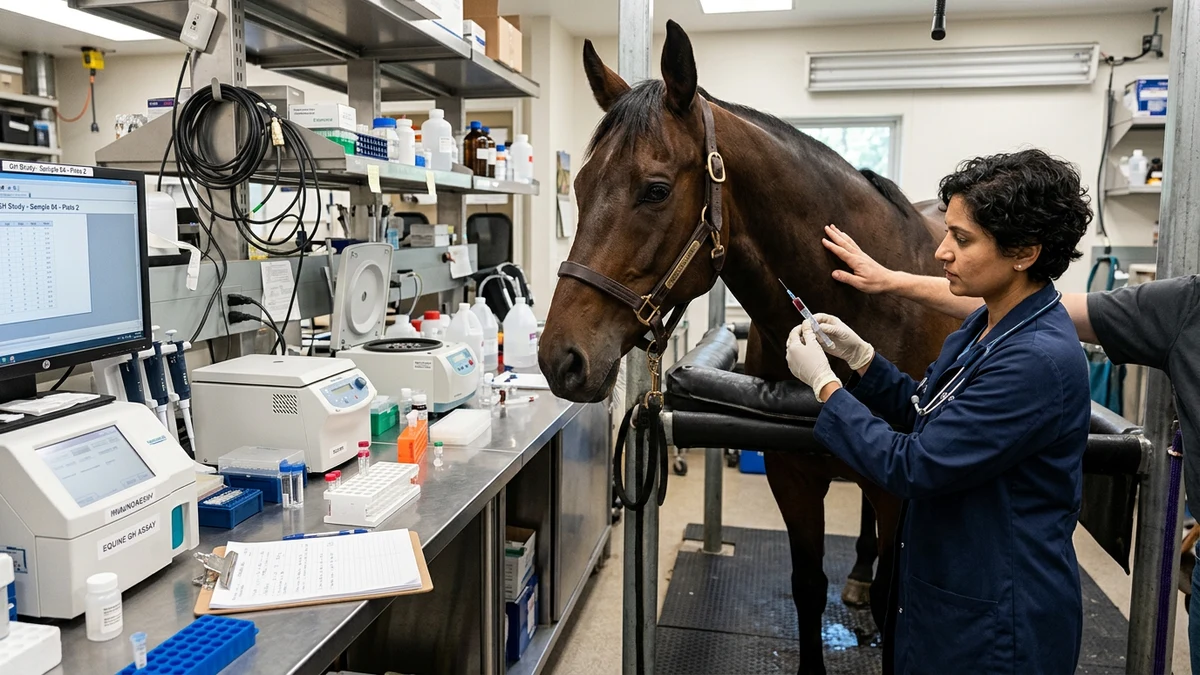
Ipamorelin equine growth hormone research sits at an intriguing crossroads of veterinary science, sports physiology, and peptide pharmacology. Over the past two decades, researchers have taken considerable interest in how synthetic growth hormone secretagogues (GHS) behave in large animal models, with horses offering a particularly instructive biological system. Equines have a well-documented somatotropic axis, meaning the pathways that regulate growth hormone (GH) release, liver-derived IGF-1 production, and downstream anabolic signaling are well-characterized enough to draw meaningful comparisons to human physiology. That combination of clinical tractability and physiological complexity makes the horse a legitimate subject for GHS research.
Ipamorelin itself is a pentapeptide that selectively stimulates the ghrelin receptor (also called the growth hormone secretagogue receptor, or GHS-R1a) without meaningfully affecting cortisol or prolactin release at research-relevant doses. This selectivity has made it a subject of interest not just in human optimization circles, but in veterinary endocrinology as well. Understanding how it performs in equine subjects helps clarify both species-specific responses and the broader biological principles that govern GHS function.
Before examining ipamorelin specifically, it helps to understand how horses regulate GH secretion. Like other mammals, horses release GH from the anterior pituitary in pulses, primarily driven by hypothalamic growth hormone-releasing hormone (GHRH). Somatostatin acts as the brake on this system, periodically suppressing GH output between pulses. The net result is an ultradian rhythm of GH secretion that varies with age, breed, nutritional status, and exercise history.
Horses show particularly pronounced age-related GH decline. Older performance horses often exhibit blunted GH pulse amplitude compared to younger animals, which has prompted veterinary researchers to ask whether exogenous GHS compounds could restore more youthful secretory patterns without disrupting other hormonal axes. This question parallels similar inquiries in human aging research, and it's one reason equine studies are considered translationally relevant even outside veterinary medicine.
Research suggests the GHS-R1a receptor is expressed in equine pituitary tissue in patterns broadly consistent with human and rodent data, though species-specific receptor binding affinities can differ. The horse's larger body mass and different metabolic rate also affect peptide pharmacokinetics in ways that don't scale linearly from rodent studies.
Several GHS compounds have been examined in equine contexts, including GHRP-2, GHRP-6, hexarelin, and the non-peptide compound MK-677 (ibutamoren). Each has a distinct pharmacological profile, and their differences matter for research design.
GHRP-6, one of the earlier synthetic GHS peptides, reliably stimulates GH release in horses but also produces notable increases in cortisol and ACTH. That side-effect profile complicates interpretation in athletic animals, where stress-hormone elevation can confound performance and recovery data. GHRP-2 tends to show stronger GH pulse amplification than GHRP-6 in equine models, but still carries some cortisol signal.
Ipamorelin's distinguishing characteristic is its relative selectivity. Research in multiple species indicates it stimulates GH release with minimal co-activation of the cortisol or prolactin pathways. For equine researchers, that cleaner signal is methodologically valuable. It allows investigators to isolate GH-mediated effects without needing to control for stress-hormone confounders. Whether that selectivity holds at all doses and in all equine subpopulations remains an open question, which is itself a useful limitation to acknowledge.
MK-677, the orally active ghrelin mimetic, has also drawn interest in equine research partly because oral administration is logistically simpler than injectable protocols in large animals. However, its longer half-life and different receptor kinetics produce a sustained rather than pulsatile GH elevation, which may not accurately reproduce physiological secretory patterns. Ipamorelin's shorter action profile allows researchers to time administration and observe pulse-like responses, making it better suited for mechanistic studies.
Much of the interest in GHS compounds in equine research originates from questions about musculoskeletal recovery. Horses competing at high levels sustain repetitive microtrauma to tendons, ligaments, and subchondral bone. The natural repair capacity of equine tendons, particularly the superficial digital flexor tendon, is notoriously limited. Scar tissue formation is the predominant healing pathway, which often leaves the structure biomechanically inferior to native tissue.
GH and IGF-1 both play recognized roles in connective tissue metabolism. IGF-1 promotes tenocyte proliferation and collagen synthesis in vitro. Research suggests that modulating the GH/IGF-1 axis through secretagogue administration could support tendon repair processes, though the clinical translation is still being worked out. This connects naturally to broader interest in peptide-assisted recovery protocols, an area that overlaps with research into BPC-157 and TB-500 (thymosin beta-4), two other peptides that have attracted attention in both human and equine recovery contexts.
Muscle mass preservation is a separate but related research question. Older horses frequently experience age-related muscle wasting, sometimes classified under the umbrella of equine metabolic syndrome or simply geriatric sarcopenia. Whether sustained low-level GH axis stimulation through ipamorelin could attenuate that loss is being explored, though the evidence base remains preliminary. Any practical application would require demonstrating not just that GH/IGF-1 levels rise, but that downstream muscle protein synthesis markers respond meaningfully.
There's also interest in the relationship between GH secretagogue administration and sleep quality in horses. GH is predominantly released during slow-wave sleep phases in humans, and some evidence suggests this pattern exists in equines as well. Ipamorelin's influence on sleep-phase GH pulsatility is an underexplored area that researchers have flagged as worth investigating.
Any discussion of GHS compounds in horses must address anti-doping frameworks, particularly given the competitive racing context in which equine health is often managed. The FEI (Fédération Equestre Internationale) and individual national racing authorities maintain prohibited substance lists that include synthetic peptide hormones and their releasing factors. Ipamorelin falls under this prohibition in most competitive contexts, not because of confirmed performance enhancement in horses specifically, but because of its pharmacological class and mechanism.
Detection methods for peptide GHS compounds in equine biological matrices have improved substantially. Urine and plasma-based assays using liquid chromatography-tandem mass spectrometry (LC-MS/MS) can now identify ipamorelin and its metabolites at low concentrations, with detection windows varying based on dose timing and individual metabolic factors. This is relevant not just for enforcement, but for research design: investigators need to understand detection parameters to design ethical post-trial washout periods.
The regulatory picture also intersects with questions about naturally occurring ghrelin and endogenous GHS activity. Horses produce ghrelin, and their pituitary GHS-R1a receptors respond to it physiologically. Drawing a regulatory line between endogenous and exogenous GHS activity is a challenge that anti-doping authorities continue to address through reference interval research.
Conducting rigorous GHS research in horses is genuinely difficult. Sample sizes are constrained by cost, animal welfare requirements, and the practical challenge of working with large, sometimes unpredictable animals. Randomized controlled trials with adequate power to detect modest hormonal changes require institutional support that most academic veterinary programs struggle to maintain.
Pharmacokinetic data for ipamorelin in horses is sparse compared to rodent or human data. The compound's half-life in equine plasma, its volume of distribution, and its tissue-level receptor occupancy dynamics have not been thoroughly characterized in published literature. Researchers working in this space often extrapolate from human or rodent pharmacokinetics, which introduces meaningful uncertainty.
Biomarker selection is another methodological challenge. GH itself is notoriously difficult to measure accurately due to its pulsatile secretion, short half-life, and assay-specific antibody cross-reactivity issues. IGF-1 is more stable and easier to measure, but it reflects integrated GH activity over days to weeks, making it a blunt tool for short-term intervention studies. Researchers have explored acid-labile subunit (ALS) and IGFBP-3 as complementary markers, though equine-specific reference ranges for these biomarkers are still being refined.
Exercise variables add another layer of complexity. GH secretion responds acutely to high-intensity exercise, a confound that must be controlled through standardized pre-collection protocols. Given that most research horses are also exercised as part of their routine care, this is rarely a simple logistical problem to solve.
One acknowledged limitation across this research area is the gap between acute GH elevation and meaningful long-term outcomes. Even if ipamorelin reliably elevates GH pulse amplitude in horses, demonstrating that this translates to accelerated tendon healing, better muscle maintenance, or improved recovery metrics requires longer-duration studies with validated outcome measures. Short-term endocrinological data, while useful mechanistically, doesn't close that loop on its own.
Equine GHS research doesn't exist in isolation. It connects to a broader landscape of peptide science that includes investigations into CJC-1295 (a GHRH analog that extends GH pulse duration), sermorelin (a truncated GHRH fragment), and combination protocols pairing GHRH analogs with GHS compounds. The rationale behind combination approaches, using one agent to prime GH release while another amplifies the pulse, is being explored in both human and veterinary contexts.
Ipamorelin is sometimes studied in combination with GHRH analogs precisely because the two mechanisms are complementary. GHRH increases GH synthesis and primes pituitary somatotrophs, while ipamorelin acts on the ghrelin receptor to trigger release. Research suggests this synergy produces greater GH output than either compound alone, which matters for study design when the goal is testing downstream physiological responses rather than just hormonal changes.
Horses, with their well-characterized pituitary anatomy and established veterinary endocrinology infrastructure, are well-positioned to serve as a large-animal validation model for these combination approaches. The data generated, even when limited, provides reference points that researchers in adjacent fields can use.
The field is still developing. Much of the existing equine GHS literature consists of small observational studies, conference abstracts, and practitioner case reports rather than peer-reviewed controlled trials. That's not a dismissal of the work, it's a realistic assessment of where the science currently stands and where formal investment could accelerate progress.
This article is for informational and research purposes only. The content presented here does not constitute medical or veterinary advice, and should not be used to guide clinical decisions for animals or humans. Any use of peptide compounds in animals should occur only under the supervision of a licensed veterinarian in compliance with applicable regulations. Refer all specific health and treatment questions to a qualified professional.