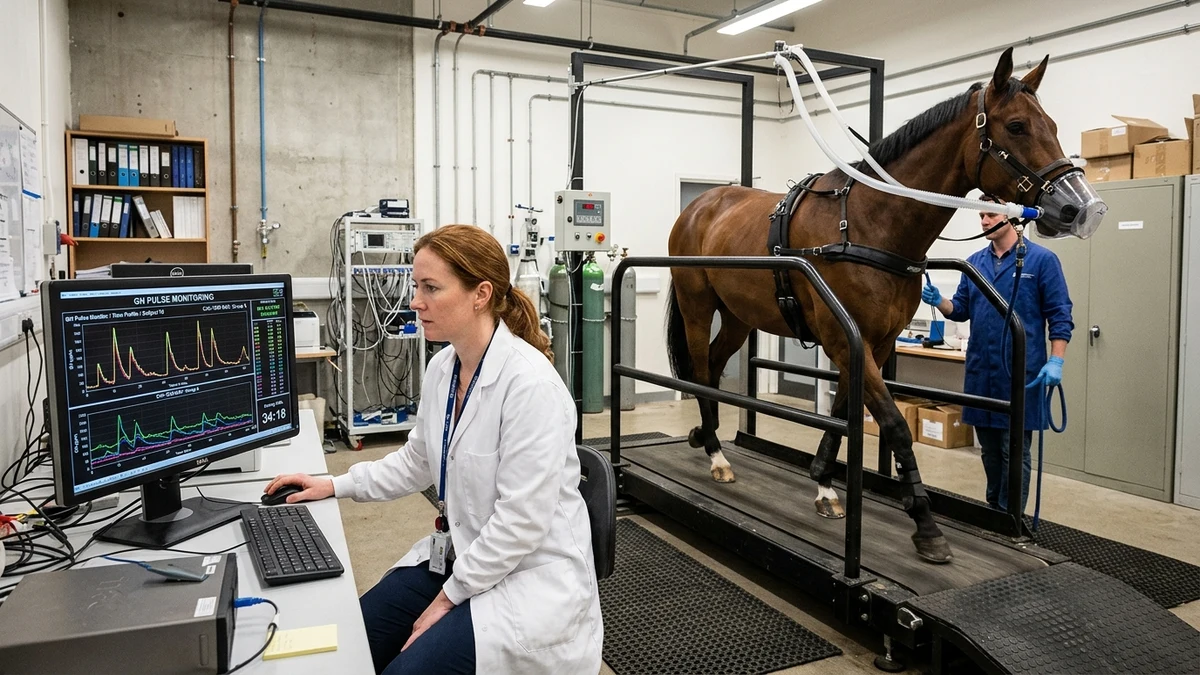
CJC-1295 DAC equine performance research sits at an unusual crossroads: a compound developed for human growth hormone studies has drawn attention from veterinary scientists and equine physiologists curious about its effects in horses. The interest isn't accidental. Horses are physiologically demanding subjects with documented growth hormone axes, and the question of how long-acting GHRH analogs behave in equine biology is a legitimate one for researchers studying muscle recovery, body composition, and metabolic signaling. This article examines what the available data suggest, where the gaps remain, and why the scientific community continues to watch this area carefully.
CJC-1295 is a synthetic analog of growth hormone-releasing hormone (GHRH), the peptide produced in the hypothalamus that signals the pituitary gland to secrete growth hormone (GH). The "DAC" designation refers to Drug Affinity Complex, a modification that binds the peptide to serum albumin and extends its half-life substantially compared to unmodified CJC-1295. In rodent models, this extended half-life has been associated with prolonged GH pulse elevation, which is distinct from the natural pulsatile pattern the body ordinarily follows.
For equine researchers, that pharmacokinetic profile raises specific questions. Horses have a well-characterized somatotropic axis, and GH plays a documented role in skeletal muscle protein synthesis, fat metabolism, and tissue repair. The equine pituitary is also sensitive to disruption, which is part of why conditions like pituitary pars intermedia dysfunction (PPID) receive so much veterinary attention. Understanding how exogenous GHRH analogs interact with this axis isn't just an academic exercise. It feeds into broader discussions about equine metabolic health, which overlaps with research on peptide compounds generally, including work on other secretagogues and recovery-focused agents studied in performance animals.
It's also worth contextualizing why the DAC form specifically draws interest. A shorter-acting GHRH analog requires frequent administration to maintain any meaningful plasma GH elevation. The DAC modification theoretically reduces that burden, making it more practical for controlled research protocols. Practicality in equine research matters: horses are large, often difficult to handle for repeated injections, and physiological stress from handling can itself confound GH measurements.
Direct peer-reviewed studies on CJC-1295 DAC in horses remain sparse. Most of the mechanistic data comes from rodent and human studies, which researchers then consider in light of comparative endocrinology. In those models, research suggests that the DAC form produces what some investigators describe as a "GH bleed," a sustained, relatively flat elevation in GH rather than the sharp peaks characteristic of natural pulsatile release.
Whether this pattern is beneficial, neutral, or potentially counterproductive in horses isn't settled. In human growth hormone research, the pulsatile nature of GH secretion is considered functionally important, with different tissue responses documented at peak versus trough concentrations. Some researchers have raised questions about whether chronically elevated GH, even at moderate levels, produces the same anabolic signaling as physiological pulses. These questions carry over directly into equine hypotheses.
In horses, GH secretion naturally peaks during sleep and exercise, and the downstream production of insulin-like growth factor 1 (IGF-1) in the liver is a key mediator of muscle and bone responses. Some practitioners working in performance horse circles report interest in IGF-1 elevation as a proxy for anabolic signaling, and GH-stimulating compounds like GHRH analogs represent one pathway being explored. Related compounds such as ipamorelin and other GH secretagogues are sometimes discussed in the same research conversations, since they act on complementary receptor pathways.
One acknowledged limitation in this field is the lack of species-specific pharmacokinetic data for CJC-1295 DAC in horses. The albumin-binding mechanism that extends half-life depends on serum albumin concentration and binding affinity, both of which can differ between species. Extrapolating human pharmacokinetic profiles to a 500-kilogram horse with different plasma protein dynamics is, at best, an educated approximation.
The hypotheses driving equine interest in CJC-1295 DAC center on muscle tissue recovery and lean body mass. GH and IGF-1 are established regulators of satellite cell activation, the process by which muscle fibers repair and hypertrophy after mechanical stress. In performance horses, this process is continuously relevant: racehorses, eventers, and sport horses experience repeated cycles of muscle microtrauma and repair across training seasons.
Research suggests that GH axis support may influence recovery timelines in large animals, though the specific contribution of exogenous GHRH analogs versus nutritional and rest-based interventions hasn't been cleanly isolated in equine populations. What practitioners and researchers have noted is that horses with documented GH deficiencies or blunted somatotropic responses tend to show poor muscle maintenance and altered body composition, lending indirect support to the idea that axis stimulation could be meaningful.
Body composition is a separate but related consideration. GH has well-documented lipolytic effects, meaning it promotes fat mobilization. In horses prone to metabolic dysfunction or those managing weight during intensive training, this pathway has theoretical relevance. The conversation here intersects with research on peptide-based metabolic support more broadly, including discussions about compounds that influence appetite regulation and fat oxidation in equine subjects.
It's important not to overstate these hypotheses. No published controlled trials have demonstrated specific body composition improvements in horses attributable to CJC-1295 DAC administration. The mechanistic reasoning is plausible and grounded in comparative endocrinology, but plausibility isn't evidence. Researchers in this space are careful to distinguish between what the biology suggests is possible and what has been demonstrated.
Any research discussion of peptide compounds in performance horses has to engage with the regulatory landscape. Organizations governing equine competition, including racing authorities and FEI-affiliated bodies, maintain prohibited substance lists that include various peptide hormones and their releasing factors. GHRH analogs fall into regulatory scrutiny partly because their downstream effects on GH and IGF-1 could confer performance advantages and partly because detection poses technical challenges.
Detecting CJC-1295 DAC in equine biological samples requires sophisticated mass spectrometry methods. The compound itself may clear plasma relatively quickly depending on the individual animal's metabolism, while downstream IGF-1 elevations could persist longer as an indirect marker. Racing laboratories have invested in developing longitudinal profiling approaches, sometimes called biological passports in the human athletics context, to capture patterns of GH axis manipulation rather than relying solely on direct compound detection.
For researchers operating outside competitive contexts, these regulatory frameworks don't directly apply, but they inform the ethical and scientific conversation. The fact that governing bodies treat GHRH analogs with serious concern signals that the compounds are considered biologically active enough to matter, which itself is informative for researchers assessing whether equine models are appropriate for studying their effects.
The most honest assessment of CJC-1295 DAC equine performance research is that the field is early. The compound has been studied meaningfully in rodent models and has entered human clinical research contexts, but horses occupy a different tier of the evidence hierarchy: physiologically interesting, practically relevant, and largely understudied with respect to this specific compound.
Several gaps stand out. Species-specific pharmacokinetics, as noted earlier, haven't been characterized. Dose-response relationships in horses are unknown. The interaction between CJC-1295 DAC and equine pituitary function over extended periods hasn't been examined, which matters given the prevalence of pituitary-related conditions in older horses. And the question of sex differences, stallions versus mares versus geldings, hasn't been addressed at all in the available literature.
Future research directions that practitioners and veterinary scientists have discussed include controlled crossover studies measuring IGF-1 response to standardized GHRH analog protocols in horses of different breeds and ages, as well as comparative work examining muscle biopsy markers after exercise cycles. Related areas of equine peptide research, including investigations into thymosin beta-4 analogs and BPC-157 in connective tissue recovery, share some methodological overlap with what a well-designed CJC-1295 DAC equine study would require. Building methodological infrastructure across these related research threads would likely accelerate progress in all of them.
The compound's profile, a long-acting GHRH analog with a defined albumin-binding mechanism, makes it a reasonable candidate for structured equine studies precisely because its pharmacology is better characterized than many alternatives. That's not a reason to draw conclusions prematurely. It's a reason to invest in the research rather than leave the field to speculation.
One practical challenge in equine GH research is the variability in baseline GH pulsatility between individual horses. Unlike rodents, where GH secretion patterns are more predictable, horses show high inter-individual variation influenced by breed, training status, age, and stress. This variability means equine CJC-1295 studies need relatively large cohorts to reach statistical conclusions, raising cost and logistical barriers. Researchers publishing in this space often acknowledge this limitation explicitly, and it's worth factoring into any interpretation of results from smaller equine studies where baseline controls may not be fully characterized.
This article is for informational and research purposes only. The content presented here does not constitute medical or veterinary advice, is not intended to diagnose or treat any condition in animals or humans, and should not be used as the basis for clinical or husbandry decisions. Peptide research compounds are not approved veterinary therapeutics unless otherwise specified by relevant regulatory authorities. Anyone involved in equine care, training, or research should consult licensed veterinary professionals before making any decisions related to animal health or physiology.
For research purposes only — not medical advice.