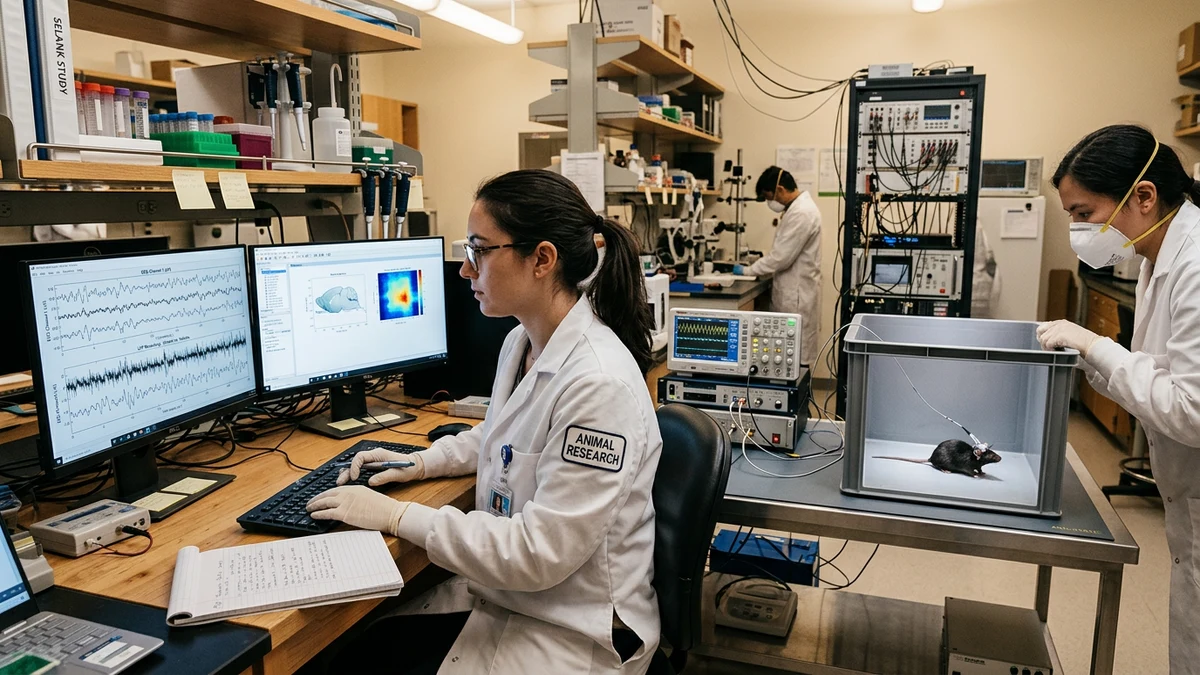
Selank anxiolytic animal research has generated steady interest among neuroscientists and peptide researchers over the past two decades. The compound, a synthetic heptapeptide derived from the endogenous immunomodulatory peptide tuftsin, was developed at the Institute of Molecular Genetics of the Russian Academy of Sciences. What draws researchers to it isn't a single dramatic finding but rather a pattern of convergent results across multiple animal model paradigms, suggesting that Selank interacts with anxiety-related neurobiological systems in measurable, reproducible ways. Understanding what those studies actually show, and where the gaps remain, requires a closer look at the methodology and the mechanisms researchers have proposed.
Researchers reviewing Selank literature should also be aware of the regulatory and publication context. Much of the primary research originates from the Institute of Molecular Genetics in Moscow, which developed the compound and holds the intellectual property. While this doesn't automatically invalidate the findings, it does mean independent replication by disinterested parties is limited. The handful of studies from other research groups have been generally positive, but the overall evidence base remains small relative to established anxiolytic compounds with decades of multicenter trial data. Approaching Selank research with that context in mind produces more accurate assessments of what the current data actually demonstrates.
This article is for informational and research purposes only. Nothing written here constitutes medical advice, and no information should be interpreted as a recommendation to use any compound discussed. All research cited refers to preclinical animal studies unless otherwise noted. Always consult a qualified healthcare professional before making any decisions related to your health.
Animal models of anxiety fall into several broad categories, and Selank has been tested across more than one of them. The elevated plus maze (EPM) is among the most commonly used. In this paradigm, rodents are placed on a raised cross-shaped platform with two open arms and two enclosed arms. Animals displaying anxiety-like behavior spend more time in the enclosed arms. Research suggests that Selank-treated rodents in EPM studies show increased open-arm exploration compared to controls, a behavioral signature consistent with anxiolytic activity.
The open field test offers a complementary data point. Here, locomotor activity and the tendency to avoid the exposed center of an arena serve as indirect measures of anxiety. Some studies examining Selank in rodents have reported that treated animals show more center-zone exploration without the hyperlocomotion that would complicate interpretation. That distinction matters because classical benzodiazepines, the reference compounds in much of this research, tend to increase overall locomotion alongside their anxiolytic effects. Selank's apparent separation of these behaviors has made it a point of interest for researchers studying anxiolytics with potentially cleaner behavioral profiles.
A smaller body of work has used conflict paradigms, including the Vogel conflict test, which pairs thirst with mild aversive stimuli to produce suppressed drinking behavior. Anxiolytics typically restore the suppressed behavior. Results from studies using this model with Selank have been less uniformly reported, which is one honest limitation of the current literature: the compound doesn't produce identical results across every paradigm, and researchers are still characterizing exactly what that pattern means mechanistically.
Selank's interaction with the GABAergic system has received the most attention in the mechanistic literature. GABA, the brain's primary inhibitory neurotransmitter, is the target of benzodiazepines and several other established anxiolytics. Research suggests Selank may modulate GABA-A receptor activity, though the precise binding dynamics differ from classical benzodiazepine pharmacology. Unlike drugs that bind directly to the benzodiazepine site, Selank appears to exert influence through indirect or modulatory pathways, which may explain why researchers observe anxiolytic-like effects without the sedation or muscle relaxation typically associated with benzodiazepine compounds in animal studies.
Serotonergic pathways have also come up in the Selank literature. Some researchers have proposed that the peptide influences serotonin metabolism, specifically the ratio of serotonin to its metabolite 5-HIAA in certain brain regions. This connection to serotonin is relevant to researchers also studying compounds like semax cognitive peptide research, which shares a structural lineage with Selank through the tuftsin-derived peptide family. The overlap in mechanistic territory between these compounds has prompted comparative studies in some laboratories, though direct head-to-head anxiolytic comparisons remain sparse.
There's also a body of work examining Selank's interaction with brain-derived neurotrophic factor (BDNF). BDNF plays a well-documented role in neuroplasticity and has been associated with resilience to stress-related behavioral changes in animal models. Some researchers have reported that Selank administration in rodents correlates with changes in BDNF expression in the hippocampus and prefrontal cortex, regions classically implicated in fear learning and anxiety regulation. Whether this relationship is causal or correlational, the studies haven't fully resolved.
Beyond classic anxiety paradigms, researchers have examined Selank in chronic stress models. Chronic unpredictable stress (CUS) protocols in rodents produce behavioral, hormonal, and neurochemical changes that model aspects of generalized anxiety and depression-like states. Studies using CUS models have reported that Selank-treated animals show attenuated stress-related behaviors, with some papers pointing to effects on corticosterone regulation. Corticosterone in rodents is the primary glucocorticoid stress hormone, analogous to cortisol in humans, and dysregulation of its release patterns underlies many of the behavioral features that emerge in CUS models.
The immunomodulatory angle adds another layer. Selank's parent structure, tuftsin, is known for its effects on immune function, and some researchers have proposed that Selank's anxiolytic profile may partly involve cytokine signaling. Interleukin-6 and tumor necrosis factor-alpha have both been flagged in preclinical anxiety research as modulators of behavior through brain-immune communication pathways. A handful of Selank studies have measured cytokine levels alongside behavioral outcomes, finding associations that researchers have interpreted as consistent with an immunomodulatory-to-behavioral signaling chain. This line of inquiry remains exploratory, and the researchers involved have generally been careful to frame their findings as hypothesis-generating.
This intersection of stress, immunity, and peptide signaling is a thread that connects Selank research to broader work on nootropic peptide immunomodulation, a growing subfield that examines how synthetic peptides derived from immune-active precursors produce central nervous system effects. It's a methodologically complex area because disentangling peripheral immune effects from direct central peptide action requires experimental designs that not all published studies have employed.
Most published Selank anxiolytic studies include a benzodiazepine control arm, typically diazepam. This comparison is standard practice and serves to validate the model. The interesting finding across several studies is that Selank produces effects in behavioral anxiety measures that are statistically comparable to diazepam doses calibrated to produce anxiolytic effects in the same model, but without the sedative profile that diazepam reliably produces at those doses in rodents.
That's a meaningful observation if it replicates cleanly. The sedation-to-anxiolysis separation is a longstanding goal in anxiolytic pharmacology, and animal data showing a peptide compound that may achieve it generates legitimate scientific interest. Researchers studying peptide receptor modulation anxiety models have pointed to this separation as a primary reason for continued investigation into Selank's mechanism, even setting aside any translational implications.
The replication picture is imperfect, though. A significant portion of the published Selank literature originates from Russian research institutions, which creates some methodological heterogeneity and limits independent replication from Western laboratories. This isn't a dismissal of those findings; it's a transparency point that systematic reviewers of the literature have raised. Independent replication in additional laboratory environments would meaningfully strengthen the evidentiary base.
Animal models of anxiety are proxies. They measure behavioral correlates of states that researchers interpret as anxiety-like, but rodent behavior in an elevated plus maze is not identical to human anxiety disorder phenomenology. This gap between preclinical behavioral data and clinical translation is a central challenge in psychopharmacology broadly, not a problem unique to Selank research.
Dosing consistency across published studies is another issue. Research suggests that the relationship between dose and behavioral effect in Selank studies follows a non-linear pattern in some reports, with mid-range doses producing clearer anxiolytic effects than either very low or high doses. This kind of dose-response complexity is common with peptide compounds but makes cross-study comparison harder when different laboratories have used different dose ranges or administration routes.
The question of intranasal versus intraperitoneal administration in animal studies also deserves acknowledgment. Selank has been studied using both routes, and because peptides face degradation challenges when administered systemically, route of administration can meaningfully affect central bioavailability and therefore behavioral outcomes. Studies haven't always reported consistent results across routes, which complicates interpretation of effect magnitude even when directional findings align.
One concrete opinion from researchers in the field: the existing animal data is sufficient to justify rigorous dose-response characterization studies in additional species, but it would be premature to treat the current literature as a settled mechanistic account. The pieces are suggestive and internally coherent. They're not yet a complete picture.
Selank anxiolytic animal research occupies a genuinely interesting position in the peptide neuroscience literature: consistent enough in behavioral outcomes to remain a legitimate object of scientific inquiry, and mechanistically complex enough that the work isn't finished. The GABAergic, serotonergic, and BDNF-related findings each point toward plausible pathways without fully resolving which of them carries the primary explanatory weight. For researchers studying peptide-based approaches to anxiety neurobiology, the animal literature offers a foundation worth examining carefully and critically.
For research purposes only — not medical advice.