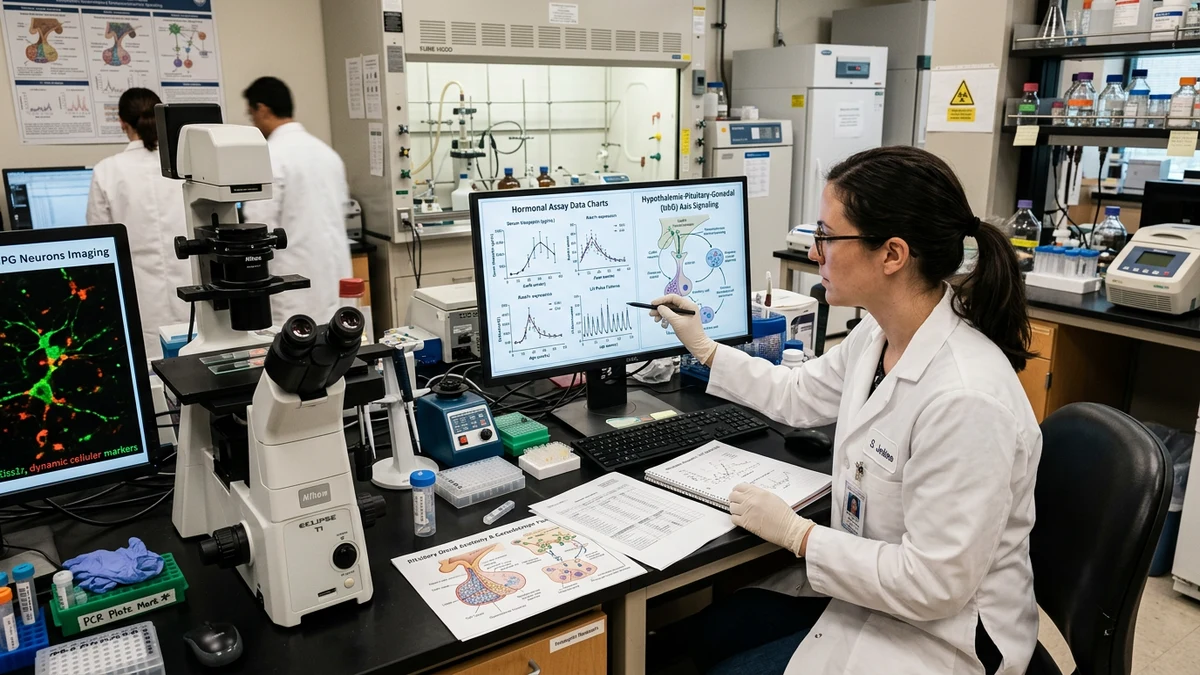
Kisspeptin reproductive animal research has reshaped how scientists think about the hormonal cascade governing fertility. What was once a poorly understood neuropeptide is now recognized as a central regulator of the hypothalamic-pituitary-gonadal (HPG) axis, the signaling pathway that controls reproductive function across virtually all mammalian species. From sheep and cattle to rodents and pigs, kisspeptin and its receptor, KISS1R, appear to sit at a critical control point in the chain of events that leads to ovulation, spermatogenesis, and successful breeding. Understanding how this system works in animal models isn't just academically interesting. It has direct implications for livestock productivity, conservation biology, and the broader science of reproductive endocrinology.
The story of kisspeptin begins not with reproduction at all, but with cancer biology. The KISS1 gene was originally identified as a metastasis suppressor in melanoma research. It wasn't until the early 2000s that two independent research groups discovered loss-of-function mutations in the KISS1R gene caused hypogonadotropic hypogonadism in humans, and the field pivoted sharply toward reproductive science. Animal researchers followed quickly, and what they found in sheep, cattle, and rodent colonies over the following two decades has been substantial.
Kisspeptin is produced by specialized neurons located primarily in two hypothalamic regions: the arcuate nucleus (ARC) and the anteroventral periventricular nucleus (AVPV). These populations behave differently and serve distinct functions. In rodents, the AVPV kisspeptin neurons appear to drive the preovulatory LH surge, the acute spike in luteinizing hormone that triggers ovulation. The ARC population, which co-expresses neurokinin B and dynorphin (the so-called KNDy neurons), is thought to generate the pulsatile release of GnRH, which in turn drives the rhythmic secretion of LH and FSH from the pituitary.
Pulse frequency matters enormously. Research in ewes has shown that kisspeptin neurons in the ARC fire in coordinated bursts that correspond precisely to LH pulses measured in peripheral blood. When researchers pharmacologically silence kisspeptin signaling in sheep, LH pulsatility drops or disappears. Restore the signal, and pulses return. This kind of tight coupling between kisspeptin neuron activity and downstream gonadotropin release makes the system a compelling target for fertility researchers trying to manipulate breeding cycles with precision.
It's also where the photoperiod connection becomes relevant. In seasonally breeding species like sheep and deer, kisspeptin neurons appear to translate day-length information into reproductive signals. Melatonin, secreted by the pineal gland in response to night length, influences kisspeptin neuron activity in a species-specific way. This is why ewes cycle in autumn and why breeding management in sheep flocks often involves manipulating light exposure. Kisspeptin sits at the intersection of these environmental and endocrine inputs.
The practical stakes in cattle and sheep reproduction are high. Reproductive inefficiency costs livestock producers substantially every year, and research groups across Europe, Australia, and North America have been investigating whether kisspeptin-based interventions could improve estrus synchronization, increase ovulation rates, or address anovulatory conditions in postpartum cows.
Postpartum anestrus in beef cattle is a well-documented problem. After calving, many cows experience a period of suppressed reproductive activity driven by negative energy balance, suckling signals, and altered neuroendocrine tone. Research suggests kisspeptin signaling is attenuated during this period. The arcuate KNDy system appears less active, LH pulse frequency is reduced, and ovarian follicles fail to mature fully. Studies in cattle have shown that exogenous kisspeptin administration can stimulate LH release even in anestrous animals, though the responses are variable and context-dependent.
In ewes, the relationship between kisspeptin and seasonal breeding has been studied with particular rigor. Research from groups in France and the UK has shown that kisspeptin neuron density and KISS1 gene expression in the hypothalamus shift with the seasons in a pattern that mirrors the animal's reproductive status. During the breeding season, kisspeptin expression is elevated; during anestrus, it falls. This is consistent with kisspeptin acting as a seasonal gate for reproductive activation, though researchers are careful to note this is correlational evidence and causal mechanisms are still being mapped.
Swine research has added another angle. Pigs are non-seasonal breeders with short estrous cycles, which makes them useful models for studying kisspeptin's acute effects on gonadotropin secretion independent of photoperiod. Studies in gilts and sows have explored whether kisspeptin analogs can reliably trigger LH surges on demand, a capability that could theoretically allow more precise control over insemination timing. Results have been promising enough to sustain continued research investment, though commercial applications remain in development.
Much of the foundational work on kisspeptin signaling has been done in mice and rats, where genetic manipulation is easier and the reproductive cycle is short enough to generate meaningful data quickly. Kiss1 knockout mice are infertile. So are Kiss1r knockout mice. This phenotype is fully reversible by kisspeptin replacement in Kiss1r-intact animals but not in receptor knockouts, confirming that the ligand-receptor interaction is essential, not redundant.
Conditional knockout models have allowed researchers to dissect which neuronal populations matter most. Selectively deleting Kiss1 from ARC neurons impairs pulsatile LH secretion and fertility. Deleting it from AVPV neurons blunts the preovulatory LH surge. These are not interchangeable populations. The research also intersects meaningfully with studies on GnRH neuron biology, since kisspeptin acts directly on GnRH neurons via KISS1R receptors on their cell membranes. GnRH neurons themselves do not produce kisspeptin, so they depend entirely on kisspeptin input from upstream neurons to generate their secretory pattern.
One acknowledged limitation worth stating plainly: rodent reproductive physiology differs from large animals in meaningful ways. The AVPV kisspeptin population that drives the LH surge in rodents is sexually dimorphic, larger in females than males. Whether this dimorphism is as pronounced in cattle or sheep is less clear. Extrapolating rodent findings to livestock requires caution, and most experienced reproductive endocrinologists would say the field is still building species-specific maps rather than applying a universal model.
The majority of kisspeptin fertility research has focused on females, but male reproductive biology has received increasing attention. In male rodents, kisspeptin signaling is necessary for normal testosterone production and spermatogenesis. Kiss1r knockout males are infertile and have significantly reduced testicular size and serum testosterone. Kisspeptin administration in intact males stimulates LH release, which subsequently drives Leydig cell testosterone synthesis.
In rams and bulls, the picture is somewhat more complex. These animals are reproductively active year-round or with broad seasonality, and their LH pulse dynamics differ from female counterparts. Research suggests that kisspeptin neurons in the ARC of males still drive GnRH pulsatility but do so under different feedback conditions. Testosterone exerts negative feedback on kisspeptin neurons, suppressing their activity at high concentrations. This feedback loop is part of how the HPG axis auto-regulates testosterone output.
There's also emerging research on kisspeptin's role in pubertal onset across species. In both male and female animals, the juvenile period is characterized by suppressed kisspeptin signaling, and puberty appears to involve a reactivation of kisspeptin neuron activity. Studies in heifers and male lambs have explored whether kisspeptin administration can advance the timing of puberty, which has obvious relevance in livestock contexts where earlier reproductive maturity translates to economic value. The results have been mixed and species-specific, which is itself a finding worth tracking.
Researchers don't always work with native kisspeptin. The naturally occurring peptide is rapidly degraded by plasma peptidases, meaning its half-life in circulation is short. This pharmacokinetic limitation has driven the development of kisspeptin analogs with modified structures designed to resist enzymatic cleavage and extend biological activity.
Kisspeptin-10, the 10-amino acid C-terminal fragment of kisspeptin-54, retains full biological activity at the KISS1R receptor and has been used extensively in animal research because of its ease of synthesis and consistent receptor binding. Longer forms, including kisspeptin-54 (the full-length human form) and kisspeptin-52 found in rodents, are also used depending on the species being studied and the specific research question. Research groups studying sheep breeding, for instance, have administered kisspeptin-10 via intravenous infusion to characterize LH pulse responses and have used implantable slow-release formulations to assess chronic effects on cycle regularity.
The design of these protocols matters. Pulsatile kisspeptin delivery more closely mimics endogenous neural firing patterns and tends to sustain LH responses better than continuous infusion, which can lead to receptor desensitization. This is a practical constraint that animal researchers have had to navigate carefully, and it connects to broader questions in the field about how best to replicate or augment natural signaling without triggering compensatory downregulation.
Conservation biology has also begun exploring kisspeptin applications, particularly for endangered ungulates and felids managed in captivity. Breeding success in zoo and conservation settings is notoriously difficult to optimize, partly because animals in artificial environments often display disrupted reproductive rhythms. Research groups working with species like the northern white rhinoceros and various wild cat species have expressed interest in kisspeptin's potential as a tool for stimulating reproductive activity in animals that fail to cycle normally under captive conditions. This work is still largely experimental, but it represents a meaningful extension of the core research on kisspeptin's reproductive biology.
The picture emerging from two decades of kisspeptin reproductive animal research is one of a system that's central but not simple. Kisspeptin doesn't act in isolation. It integrates inputs from metabolic sensors, circadian and photoperiod signals, steroid feedback, and stress pathways. Each species studied adds new layers to the model, and each new layer reveals how much species-specific variation exists beneath what superficially looks like a conserved signaling mechanism. The research is far from complete, and that's what makes it a productive area for continued investigation in both basic science and applied animal production contexts.
This article is for informational and research purposes only and does not constitute veterinary or medical advice. The information presented here is intended to support scientific literacy and awareness of ongoing research areas. Any application of this material in animal husbandry, veterinary practice, or clinical settings should be carried out under the supervision of qualified professionals with appropriate expertise. For research purposes only — not medical advice.