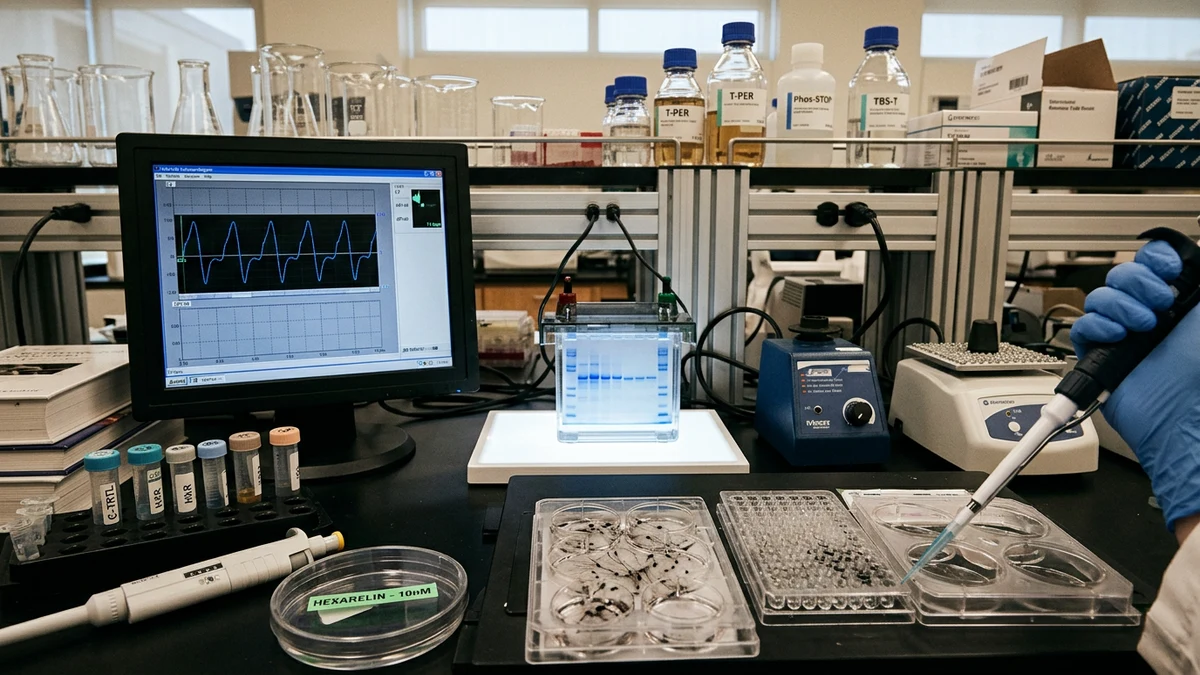
Hexarelin cardiac protection animal research has attracted steady scientific attention over the past two decades, largely because the peptide behaves in ways that go beyond simple growth hormone secretion. Unlike many compounds studied primarily for body composition or recovery, hexarelin appears to interact directly with cardiac tissue through receptor pathways that researchers are still working to fully characterize. That dual activity, growth hormone-releasing on one hand and seemingly cardioactive on the other, is what makes it an interesting subject for preclinical investigation. This article examines what animal models have shown, where the limitations lie, and how those findings relate to broader peptide research on tissue repair and metabolic signaling.
Hexarelin is a synthetic hexapeptide, a ghrelin mimetic that binds to growth hormone secretagogue receptors (GHS-R). It was originally studied in the context of growth hormone release, and early preclinical work confirmed it stimulated robust GH pulses in rodent models. The cardiac angle emerged somewhat accidentally. Researchers noticed that hexarelin produced cardiovascular effects that didn't fully map onto GH secretion alone, meaning the timeline and magnitude of certain cardiac responses didn't match what you'd expect from GH-mediated signaling.
Subsequent work identified CD36, a scavenger receptor expressed on cardiac muscle and other tissues, as a secondary binding site for hexarelin. CD36 is involved in fatty acid transport and has been linked to cardiac metabolism, lipid accumulation in myocardial cells, and ischemic signaling. The discovery that hexarelin could bind CD36 opened a separate line of investigation from the GH axis entirely. Some researchers in the field now treat these as two partially overlapping but mechanistically distinct areas of study.
This is relevant because much of the cardiac-specific research on hexarelin has been conducted in animal models where GH secretion was either absent or deliberately suppressed, allowing investigators to isolate the direct receptor effects on heart tissue. Rat and mouse models with induced cardiac dysfunction have been the primary platforms here.
A significant portion of hexarelin cardiac protection animal research has used ischemia-reperfusion injury protocols. In these models, researchers temporarily restrict blood flow to a region of the heart and then restore it, mimicking the kind of cellular stress that occurs in real cardiac events. The reperfusion phase, paradoxically, causes a burst of oxidative damage that compounds the original injury.
In several rodent studies, hexarelin administration before or during the ischemic period was associated with measurable differences in infarct size and functional recovery compared to control groups. Research suggests that treated animals showed better preservation of left ventricular contractile function in the post-reperfusion window. These results were observed across independent laboratories using different induction methods, which gives them modest credibility, though replication in non-rodent species remains limited.
The proposed mechanisms discussed in preclinical literature include activation of pro-survival intracellular pathways, particularly those involving PI3K/Akt signaling. Akt activation is a well-characterized component of what's sometimes called the Reperfusion Injury Salvage Kinase (RISK) pathway. Hexarelin's apparent ability to engage this pathway in cardiac cells is the primary mechanistic hypothesis, though direct causal confirmation in living animal systems requires more controlled study designs than most published work has employed.
It's also worth noting that some studies found effects at GHS-R1a knockout models, which suggests the CD36 pathway contributes independently. This dual receptor engagement makes clean mechanistic attribution harder and is a genuine limitation in interpreting the existing data.
Beyond ischemia, another line of hexarelin cardiac protection animal research has examined hypertension-induced cardiac remodeling. Chronic pressure overload, typically induced in rodents through aortic banding, causes the heart to undergo pathological hypertrophy, where the walls thicken in ways that impair rather than assist function over time. Fibrosis, the replacement of flexible myocardial tissue with collagen-rich scar-like deposits, is a major driver of long-term dysfunction in these models.
Animal studies using this protocol have reported that hexarelin-treated groups showed attenuation of fibrotic markers compared to untreated controls. Collagen deposition appeared lower in treated animals, and some studies measured changes in TGF-beta expression, a cytokine centrally involved in fibrotic signaling. Research suggests hexarelin may modulate TGF-beta-related pathways in cardiac tissue, though the exact upstream trigger for that modulation isn't settled.
The relevance of these findings extends to related areas of peptide research. Compounds like BPC-157 have been studied for tissue repair and anti-fibrotic effects in non-cardiac contexts, and there's growing interest in whether growth hormone secretagogues as a class share overlapping repair-related properties. Hexarelin sits in an interesting position here because its GHS-R and CD36 binding gives it a mechanistic profile that differs from peptides acting purely through growth factor cascades.
Age-related cardiac decline is its own research area, and hexarelin has been examined in aged rodent models where GH secretion is naturally reduced. Older animals tend to show decreased GH pulse amplitude, and the downstream effects on cardiac tissue include reduced contractility and impaired stress response.
Some researchers have used hexarelin in these aging protocols to ask whether restoring GHS-R stimulation can recover some of the cardiac functional decline associated with the age-related GH axis slowdown. The results have been mixed. Certain studies found improvements in echocardiographic markers of function. Others found attenuated benefits compared to younger animals, suggesting that receptor sensitivity or downstream signaling capacity may diminish with age in ways that limit hexarelin's effectiveness as a compensatory tool.
This kind of honest null or partial result is important for the field. Animal research on peptides tends to accumulate positive findings more easily than negative ones, partly because null studies face publication barriers. Acknowledging that hexarelin doesn't appear to fully reverse age-related cardiac remodeling in older animal models is a necessary piece of the picture.
The aging research context also connects naturally to discussions of IGF-1 and growth hormone optimization, which are adjacent topics in the peptide research space. Hexarelin's effects on the GH/IGF-1 axis in aged animals are somewhat unpredictable because of the desensitization that comes with repeated administration. Researchers have observed tachyphylaxis, a reduction in responsiveness with repeated dosing, as a real limitation in long-duration animal protocols.
One of the genuinely complicated aspects of interpreting hexarelin cardiac protection animal research is receptor promiscuity. Hexarelin doesn't bind just one target. GHS-R1a and CD36 are both implicated, and at higher concentrations used in some animal studies, off-target activity becomes a consideration. This makes it difficult to design clean mechanistic experiments and even harder to extrapolate dose-response relationships across species.
CD36's role is particularly interesting because the receptor is expressed in multiple tissues, including macrophages, endothelial cells, and skeletal muscle. The cardiac effects observed in animal studies could involve direct action on cardiomyocytes, indirect modulation through endothelial signaling, or some combination. Teasing those apart requires cell-specific knockout models or tissue-isolated preparations, and not all published work has gone to those lengths.
There's also the question of what happens after GH secretion. Even in studies where researchers have tried to isolate direct cardiac effects by suppressing GH release, the downstream IGF-1 axis is still operating in background. IGF-1 has its own cardioprotective properties described in the literature, so attributing observed cardiac outcomes purely to hexarelin-receptor interactions requires careful experimental controls that some preclinical studies simply haven't included.
The relationship between hexarelin research and broader investigations into peptides like GHRP-6 and GHRP-2 is relevant here. All three are growth hormone secretagogues with overlapping but non-identical receptor profiles. Comparative studies across this class could help isolate which effects are shared by the secretagogue mechanism broadly and which are specific to hexarelin's unique binding characteristics. That comparative work exists but remains sparse.
Translating animal model findings to any meaningful clinical framework is a challenge the field openly acknowledges. Rodent cardiac physiology differs from human cardiac physiology in heart rate, metabolic rate, and the relative contribution of various energy substrates to myocardial function. A compound that shows measurable cardioprotective signals in a rat ischemia model may behave entirely differently in a larger mammal or in a human context.
No human clinical trials on hexarelin for cardiac outcomes have been completed and published to date. Some early phase work examined hexarelin's GH-releasing properties in humans with GH deficiency, confirming biological activity at the pituitary level, but cardiac-specific human data doesn't exist in the peer-reviewed literature. This is the central gap between what animal research suggests and what practitioners or researchers could say with any confidence about human application.
The preclinical body of work on hexarelin cardiac protection is legitimate in the sense that it uses recognized methodologies and has been produced by multiple independent research groups. The limitation is scale and translational distance. Animal studies are hypothesis-generating, and the hypotheses generated by hexarelin research are specific enough to be testable in more complex models or eventually in human trials. Whether that investigative path gets pursued depends on factors well outside the science itself.
For those following peptide research as it relates to metabolic health, muscle preservation, and tissue repair, hexarelin occupies a niche that overlaps with several active areas of investigation. Its cardiac research profile adds a dimension that growth hormone secretagogues without CD36 activity simply don't have.
This article is for informational and research purposes only and does not constitute medical advice. Hexarelin and related compounds are not approved therapeutic agents in most jurisdictions. Nothing in this article should be interpreted as a recommendation to use, obtain, or administer any peptide compound. Readers with health concerns should consult a licensed medical professional. For research purposes only, not medical advice.