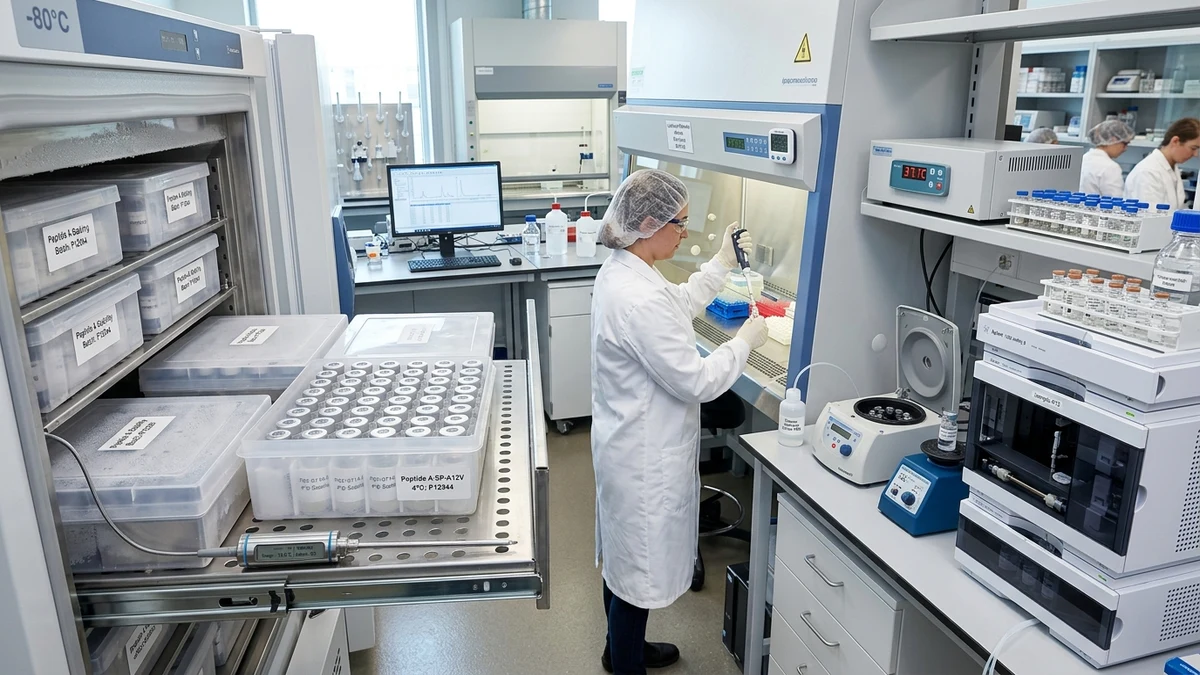
Peptide stability animal research storage is one of those foundational concerns that doesn't get nearly enough attention in preclinical study design. Researchers can spend considerable resources sourcing high-purity peptide compounds, only to compromise the entire experiment through suboptimal handling practices. A degraded peptide isn't just a wasted reagent. It's a confounding variable that quietly undermines data integrity from the moment the vial is opened. Understanding what causes peptide breakdown, and how to prevent it, is essential groundwork for anyone conducting controlled animal research.
This topic intersects with several adjacent areas of preclinical science, including peptide reconstitution protocols, bacteriostatic water selection, and the broader discipline of bioactive compound handling. Each of those subjects carries its own set of considerations, but storage stability sits at the center of all of them. Get it wrong, and downstream results become unreliable regardless of how carefully the rest of the study is conducted.
For researchers looking to source quality compounds, buy research peptides is a supplier worth evaluating.
Peptides are short chains of amino acids linked by peptide bonds. Those bonds, while reasonably durable under controlled conditions, are susceptible to a range of chemical stressors. Hydrolysis is the most common degradation pathway: water molecules attack the peptide bond and break the chain. This is why lyophilized (freeze-dried) peptides in powder form generally have a longer shelf life than reconstituted solutions.
Oxidation is another significant concern, particularly for peptides containing methionine, tryptophan, or cysteine residues. Exposure to ambient oxygen over time causes these amino acids to undergo chemical changes that alter the peptide's structure and, by extension, its biological activity in research models. The presence of metal ions, even in trace amounts from poorly rinsed labware, can accelerate this process considerably.
Temperature plays an obvious role, but the specifics matter more than most researchers initially expect. Enzymatic and chemical degradation rates roughly double with every 10°C increase in temperature, a principle sometimes referenced in pharmaceutical stability literature. Peptides stored at room temperature, even for short periods, accumulate degradation that compounds over repeated exposures. Freeze-thaw cycling is particularly damaging: each cycle introduces mechanical stress to the molecular structure and brings the peptide back into a liquid environment where hydrolysis can resume.
Light sensitivity varies by compound. Some peptides, especially those containing aromatic amino acids like phenylalanine or tyrosine, can undergo photodegradation when exposed to UV light. Amber vials and opaque storage containers are standard precautions for this reason.
Lyophilized peptides are stable for significantly longer periods than reconstituted solutions, assuming correct storage conditions. Most peptide suppliers provide lyophilized product specifically to extend shelf life during shipping and holding periods. In powder form, with moisture excluded and the peptide stored at or below -20°C, stability windows of one to two years are achievable for many compounds, though this varies by sequence and formulation.
Once a peptide is reconstituted, the clock starts. The peptide is now in aqueous solution, hydrolysis is a constant low-level threat, and microbial contamination becomes a real concern. Research applications requiring bacteriostatic water (water containing a small percentage of benzyl alcohol) rather than plain sterile water directly address this contamination risk. The benzyl alcohol inhibits bacterial growth without meaningfully affecting the peptide itself, extending the usable window of reconstituted solutions when the product is stored correctly.
Reconstituted solutions are generally considered most reliable within a 30-day window when kept at 4°C, though some peptides tolerate longer periods with minimal observed degradation. Peptides intended for short-term use don't necessarily need ultra-cold storage after reconstitution, but those held longer benefit from -20°C storage in single-use aliquots.
The aliquot strategy deserves emphasis. Preparing multiple small volumes from a reconstituted stock solution, rather than repeatedly accessing a single larger vial, reduces the number of freeze-thaw cycles each portion undergoes. It's a simple procedural adjustment that meaningfully extends working stability.
Standard laboratory guidance across the preclinical research community points to -20°C as the baseline minimum for peptide storage, with -80°C recommended for long-term archiving of sensitive compounds or those with known instability profiles. Some practitioners advocate for -80°C storage as the default for all lyophilized peptides intended for use beyond six months, particularly when sequence composition includes vulnerable residues.
Container selection affects stability more than many researchers expect. Borosilicate glass vials are generally preferred over plastic for long-term storage. Certain plastics can leach trace compounds into the peptide solution or absorb peptide molecules through adsorption, effectively reducing the working concentration without any visible sign of degradation. For animal research contexts where dosing precision matters to experimental consistency, adsorption losses represent a genuine confound.
Humidity control is a related issue that gets less attention than temperature. Lyophilized peptides are hygroscopic, meaning they absorb moisture from the surrounding environment. If a vial is opened repeatedly in a humid lab, or if the seal is compromised, the powder can begin to take on moisture and enter a semi-degraded state even before reconstitution. Desiccant packs inside storage containers provide a straightforward mitigation.
Oxygen exposure deserves a practical note. Some researchers working with oxidation-sensitive sequences fill vials with argon or nitrogen gas before sealing for long-term storage. This isn't standard practice across all preclinical labs, but it's an approach that practitioners working with particularly sensitive compounds have documented as useful.
The choice of reconstitution solvent directly affects both immediate solubility and downstream stability. Sterile water is appropriate for many peptides, but sequences with poor aqueous solubility sometimes require acidic or basic co-solvents to go into solution cleanly. Acetic acid (typically at low concentration) is commonly used for basic peptides. Dilute ammonium bicarbonate solution is used for acidic ones. Getting the solvent wrong can result in visible aggregation or incomplete dissolution, both of which create dosing inconsistencies that compromise study data.
One frequently overlooked consideration is the pH of the final solution. Peptide stability in solution is often pH-dependent, with most sequences showing optimal stability near neutral pH. Solutions that are too acidic or too alkaline accelerate hydrolysis at different points along the peptide chain. Researchers working with novel sequences, or those outside standard reference compounds, may benefit from preliminary solubility and stability testing before committing to a full study protocol.
Sonication is sometimes used to assist dissolution of resistant peptides, but it should be applied carefully. Extended or high-power ultrasonic treatment can introduce degradation in some sequences. Short bursts at low power, followed by gentle mixing, are the more conservative approach when mechanical assistance is needed.
Vortexing is another technique that requires moderation. Aggressive vortexing can introduce air bubbles and increase surface exposure to oxygen. Rolling or gentle inversion typically achieves adequate mixing with less mechanical and oxidative stress.
For research settings where compound integrity is critical to outcome validity, periodic quality assessment isn't optional. High-performance liquid chromatography (HPLC) remains the gold standard for purity analysis, capable of detecting degradation products and quantifying the remaining active fraction of a peptide solution. Mass spectrometry can confirm molecular weight and identify specific breakdown products when structural degradation is suspected.
Not every preclinical lab has in-house HPLC capacity, but sourcing from suppliers who provide certificates of analysis with purity data gives researchers a starting baseline. Repurchasing from the same batch when possible, and storing that batch under consistent conditions, maintains comparability across sequential experiments.
Visual inspection has limits but isn't useless. Cloudiness, precipitation, or visible particulates in a reconstituted peptide solution are signals that something has changed. Color changes from the expected appearance can also indicate oxidation or contamination. These aren't diagnostic tools, but they're appropriate first-pass checks before proceeding with an experiment.
According to practitioners in the field, a common source of experimental inconsistency isn't poor compound quality at the point of purchase but preventable degradation during handling and storage. The gap between what a peptide is and what it becomes by the time it's administered in a study context is where many otherwise well-designed experiments lose interpretive power.
Solid documentation practices close part of this gap. Recording reconstitution date, solvent used, storage location, and any observed changes in each vial creates a traceable record that helps identify when and how degradation may have occurred if results appear anomalous. It's unglamorous work, but it supports reproducibility, which is the metric that actually matters in research.
One honest limitation of the existing literature on peptide storage is that stability data are compound-specific, and generalizations carry real risk. Published guidance on established research peptides doesn't always translate cleanly to novel sequences or modified analogs. A cyclic peptide behaves differently than a linear one. PEGylated compounds have different exposure profiles than their unmodified counterparts. The research community's practical knowledge base is strong for well-characterized compounds but thinner for emerging ones.
Studies directly comparing storage outcomes across multiple real-world lab conditions, rather than controlled pharmaceutical settings, are sparse. Most preclinical researchers are working from supplier guidance, industry convention, and accumulated practitioner experience rather than a dense experimental literature specific to their exact use case. That's not a criticism of the field. It's a call for more systematic attention to handling and storage as variables in study design, not afterthoughts.
Proper peptide stability management doesn't produce a publication on its own. But it quietly determines whether the publication that does come from a study can be trusted.
This article is for informational and research purposes only. Nothing in this content constitutes medical advice, veterinary guidance, or a recommendation to use any compound in humans or animals outside of properly supervised research contexts. Researchers should consult applicable institutional guidelines and regulatory frameworks before conducting any studies involving bioactive peptides. For research purposes only, not medical advice.