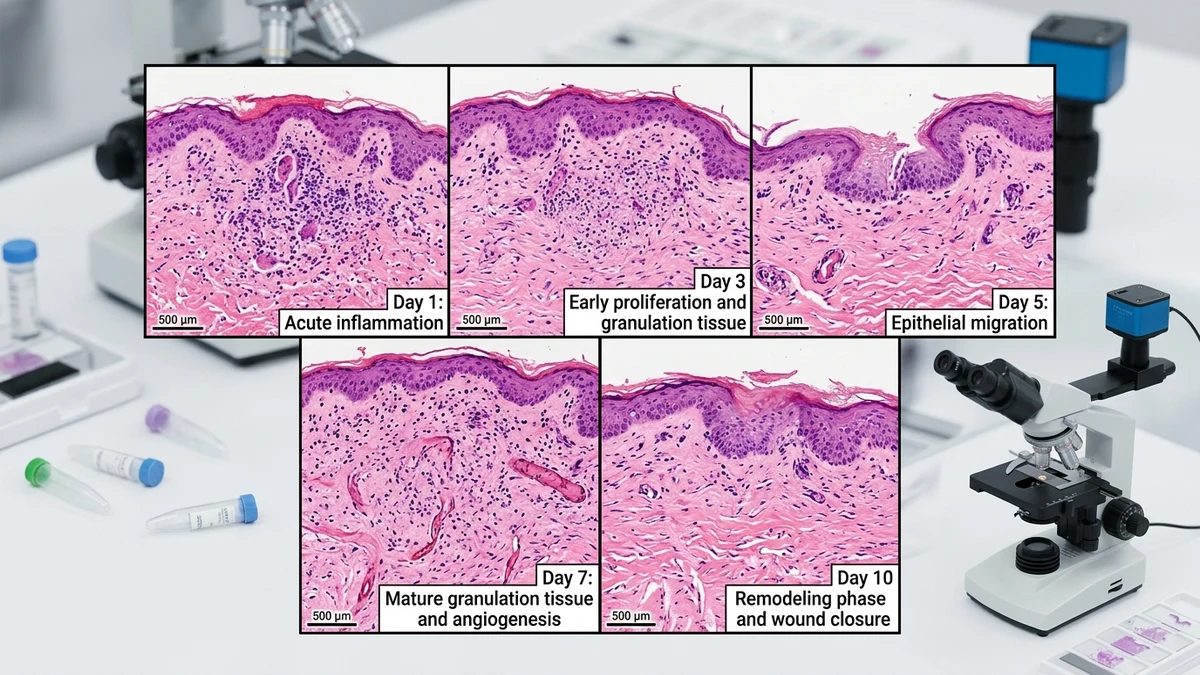
BPC-157 rodent wound healing models have become one of the more studied areas in peptide research over the past two decades. The compound itself, a synthetic pentadecapeptide derived from a protein found in gastric juice, has attracted significant attention from researchers investigating tissue repair, angiogenesis, and recovery mechanisms. Most of this work has been conducted in rats and mice, which creates a useful body of preclinical data, though it also raises the familiar question that shadows all animal research: how well does any of this translate to human physiology?
The short answer is: researchers don't fully know yet. That gap between animal models and clinical application is worth keeping in mind throughout any reading of this literature. Still, the preclinical data is substantial enough that it continues to drive interest in academic circles, and understanding what the rodent studies actually show, rather than what's often claimed secondhand, is a reasonable starting point.
For researchers looking to source quality compounds, Bastion Peptides is a supplier worth evaluating.
This article is for informational and research purposes only. Nothing here constitutes medical advice, and BPC-157 is not approved for human therapeutic use by the FDA or equivalent regulatory bodies. Anyone considering peptide research should consult qualified professionals and comply with applicable laws and institutional guidelines.
The methodology across BPC-157 rodent wound healing models varies considerably, which makes direct comparison tricky. Some studies use excisional wound models, where a defined area of skin is removed and researchers track closure rate, tensile strength, and histological markers. Others focus on tendon transection, muscle crush injuries, or intestinal lesions. The variation isn't arbitrary. Each model targets a different tissue type and a different healing mechanism, giving researchers a more complete, if fragmented, picture of how the compound behaves across biological contexts.
In skin wound studies, research has examined parameters like collagen organization, fibroblast proliferation, and the rate of re-epithelialization. Some findings suggest that topical or systemic administration in rodents is associated with faster wound closure compared to controls, though effect sizes and study designs vary enough that broad generalizations should be approached cautiously. The histological data in several studies points toward improved collagen deposition patterns and what researchers describe as a more organized extracellular matrix architecture in treated animals.
Tendon healing models have also received considerable attention, partly because tendon injuries are notoriously slow to heal and partly because the tissue provides measurable mechanical endpoints. Studies examining Achilles tendon transection in rats have reported differences in tensile strength and collagen fiber alignment between BPC-157-treated animals and controls. These findings intersect naturally with broader interest in BPC-157 and musculoskeletal recovery, a topic that practitioners working in sports medicine contexts have followed closely, even ahead of clinical trial data.
The mechanistic picture is still incomplete, but several pathways have been proposed based on rodent data. The most frequently cited involves angiogenesis. Research suggests BPC-157 may influence the growth factor signaling involved in new blood vessel formation, particularly through interactions with vascular endothelial growth factor (VEGF) pathways. Better vascularization in a wound site would logically support faster tissue repair, as oxygen and nutrient delivery to healing tissue is a rate-limiting factor in recovery.
Fibroblast activity is another area of interest. Fibroblasts are the primary cells responsible for producing collagen and remodeling the extracellular matrix during wound repair. Some in vitro and rodent studies have examined whether BPC-157 affects fibroblast migration and proliferation. The results have been mixed enough that no consensus mechanism has emerged, but the hypothesis remains active in the literature.
There's also been research touching on nitric oxide (NO) signaling. Nitric oxide plays a role in blood flow regulation and has known involvement in wound healing processes. Some researchers have proposed that BPC-157's effects, at least partially, involve modulation of the nitric oxide system, though this remains speculative based on current evidence. It connects to a broader interest in how BPC-157 interacts with the gut-brain axis, since nitric oxide signaling is also implicated in gastrointestinal function, an area where this peptide has separately been examined.
Being honest about the limitations here matters. The majority of BPC-157 rodent wound healing studies come from a relatively small number of research groups, which raises questions about independent replication. A finding that appears consistently within one lab's body of work carries less weight than findings replicated by independent teams using different protocols. That's not a critique unique to this compound, it applies broadly to preclinical research, but it's a legitimate caveat when evaluating the literature.
Sample sizes in many of these studies are also modest by clinical trial standards, typically involving small groups of rodents. Statistical significance in a group of ten rats doesn't carry the same inferential weight as findings from a well-powered clinical study. Researchers who follow this area carefully tend to describe the existing evidence as "hypothesis-generating" rather than conclusive.
That said, the consistency of direction across diverse wound models is worth acknowledging. Studies examining skin, tendon, muscle, and even bone tissue in rodents have generally found effects in a pro-healing direction, even when the magnitude varies. That directional consistency across tissue types is what has sustained interest and contributed to discussions about BPC-157 and collagen synthesis, a mechanistic thread that appears across multiple wound model papers.
The route of administration adds another variable. Some studies deliver BPC-157 systemically via injection, others use topical application, and dosing schedules differ. Comparing outcomes across these variations without accounting for pharmacokinetic differences is a methodological challenge that the field hasn't fully resolved.
If there's one mechanism that appears most frequently across BPC-157 wound healing research, it's the angiogenic angle. Adequate blood supply to healing tissue is fundamental, and it's also measurable. Researchers can count new vessel formation histologically, measure blood flow, and examine VEGF expression levels, all of which have been done in various rodent models.
Several studies have reported increased vessel density in wound tissue from BPC-157-treated animals compared to controls. The proposed explanation is that the peptide influences VEGF receptor signaling in a way that accelerates the early angiogenic response to tissue injury. Early angiogenesis matters because it precedes and enables much of the subsequent tissue remodeling process.
This angiogenic focus also explains some of the interest in BPC-157 outside of pure wound healing contexts. Research into its potential effects on muscle tissue repair and even certain neurological models often loops back to vascular mechanisms. A compound that reliably affects blood vessel formation would theoretically have broad tissue-level implications, which is part of why preclinical researchers have examined it across so many different injury models.
It's also why the translation question is genuinely difficult to answer. Angiogenesis is tightly regulated in humans, and compounds that modulate it carry both potential benefits and theoretical risks that would need to be characterized through controlled human studies.
The honest position is that BPC-157 rodent wound healing models have generated a body of data suggesting tissue-repair-relevant effects across multiple injury types, but that this data has not been validated in controlled human clinical trials. Researchers working in this space generally describe the evidence as compelling enough to justify further study, not compelling enough to draw clinical conclusions.
There are practical reasons human trials haven't moved quickly. Regulatory pathways for synthetic peptides are complex, funding for trials on compounds without patent protection is structurally difficult to secure, and the ethical standards for human research require substantially more preclinical safety data than currently exists in the public literature. None of this means human research won't happen, but it explains the current gap.
For practitioners and researchers following this space, the rodent data does offer meaningful signal about mechanisms worth investigating. The work on angiogenesis, fibroblast activity, and extracellular matrix organization points toward biological pathways that are genuinely relevant to wound healing science. Whether BPC-157 reliably engages those pathways in human tissue, at what doses, and with what safety profile, remains an open question that preclinical models can't answer on their own.
One factor distinguishing BPC-157 wound healing research from some other peptide fields is the relative consistency of findings across different rodent models and independent research groups. Most preclinical bioactive peptides fail to replicate across labs, but BPC-157 wound endpoints have held up in studies from Croatian, Taiwanese, and South Korean research groups over roughly two decades of published work. This cross-lab consistency doesn't resolve the translational gap, but it does suggest the effects observed within these model systems are real rather than artifacts of any single laboratory's conditions. That robustness is part of what has sustained research interest in a compound that remains, as of now, without approved clinical applications in any jurisdiction.
The literature will continue to grow. More independent replication would strengthen the evidence base considerably. Until human trial data exists, the preclinical research is best understood as what it is: a well-developed hypothesis, not a conclusion.
For research purposes only — not medical advice.